The pain caused by pressure or even simple touch is one of the most common symptoms among people suffering from chronic pain; however, the biological mechanisms that trigger it are still poorly understood. Now, a study conducted by the Sensory Transduction and Nociception laboratory at the Institute for Neurosciences (IN), a joint centre of the Spanish National Research Council (CSIC) and the Miguel Hernández University of Elche (UMH), has shed light on one of the processes involved in this type of pain. Published in the journal PAIN, the work shows that Piezo2, a protein present in sensory neurons, plays a key role in the mechanical hypersensitivity associated with neuropathic pain.
This study has focused on a specific group of sensory neurons in the peripheral nervous system known as MrgprD nociceptors. These neurons express high levels of Piezo2, a mechanical sensor that enables the detection of physical stimuli such as pressure. This protein belongs to a family of ion channels involved in the sense of touch, whose discovery was recognized with the 2021 Nobel Prize in Physiology or Medicine awarded to researchers David Julius and Ardem Patapoutian.
“Mechanical pain is one of the most disabling symptoms in many patients with chronic pain, yet we still know little about how it originates at the molecular level”, explains researcher Ana Gomis, who led the study. “Our results show that Piezo2 is a key element that enables certain sensory neurons to develop this exaggerated pain response after a nerve injury”, she adds.
A molecular ‘switch’ for pain
To understand the function of Piezo2, the researchers developed a mouse model in which this ion channel was selectively deleted from MrgprD neurons. This approach allowed the team to investigate how the ability to detect mechanical stimuli was affected when MrgprD nociceptors did not express the Piezo2 channel.
The experiments showed that, without Piezo2, the neurons hardly responded to mechanical pressure. Moreover, when the animals suffered a nerve injury similar to those that cause neuropathic pain in humans, pain hypersensitivity was significantly reduced. “We observed that Piezo2 not only participates in the detection of painful mechanical stimuli, but is also crucial for neurons to become hypersensitive after injury”, says Jorge Fernández Trillo, first author of the paper.
To induce this neuropathic pain state, the team used an experimental model based on a chronic injury to the sciatic nerve. They then assessed the mice’s sensitivity by applying mechanical stimuli of varying intensity to the skin and analyzing both their behavior and the response of sensory neurons. To do so, they used in vivo calcium imaging techniques, which allowed them to observe the activity of hundreds of neurons in real time while mechanical stimuli were applied to the skin of anesthetized animals.
The results showed that MrgprD neurons primarily respond to strong, potentially harmful mechanical stimuli, but barely react to gentle tactile stimulation such as a caress or light brushing. After nerve injury, these neurons responded much more intensely, a phenomenon characteristic of chronic pain hypersensitivity. However, this increased response was almost completely absent when Piezo2 was removed.
“These techniques allowed us to directly observe how neuronal activity changes during neuropathic pain”, explains Fernández Trillo. “When we removed Piezo2, neurons no longer showed the exaggerated response that characterizes mechanical hyperalgesia”, notes the researcher.
In addition to altering pain sensitivity, the absence of Piezo2 also partially modified the organization of nerve fibers in the skin. The results suggest that this channel could play an additional role in the structure and distribution of sensory nerve endings.
Neuropathic pain affects millions of people and often manifests as an exaggerated response to touch or everyday mechanical stimuli. In this context, the authors highlight that these findings could contribute to the development of new therapies for this type of pain, which often responds poorly to current treatments.
Moreover, since the neurons studied are located in the outermost layers of the skin, Piezo2 could become a particularly accessible target for future topical therapies. “Although there is still much work to be done, our results identify Piezo2 as a potential therapeutic target for reducing chronic mechanical pain”, Gomis notes.
Piezo2 mediates mechanical sensitivity and injury-induced hypersensitivity in MrgprD-expressing nociceptors. Fernández-Trillo, J., Villaro-Capellán, M., de la Peña, E., Viana, F. & Gomis, A. PAIN (2026) 167(6):1404-141
DOI https://doi.org/10.1097/j.pain.0000000000003954
This study was possible thanks to funding from the Spanish Ministry of Science, Innovation and Universities, the Spanish State Research Agency (AEI), the PROMETEO programme of the Generalitat Valenciana, the Severo Ochoa Programme for Centres of Excellence, the European Regional Development Fund (ERDF) “A way of making Europe”, and the International Center for Aging Research (ICAR).
Source: Institute for Neurosciences CSIC-UMH (in.comunicacion@umh.es)
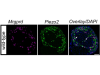
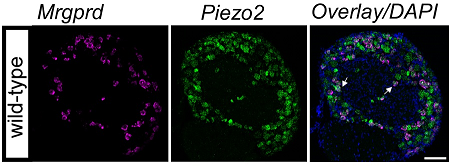
Image: The image shows sensory neurons involved in pain perception. The colours identify two different molecules: MrgprD (magenta) and Piezo2 (green), a protein involved in the detection of mechanical stimuli. Cells appearing in both colours express both molecules. Source: PAIN.

La mejor actitud que podemos adoptar es la de trat...

The research team observed changes in head circumf...
AtCDF3 gene induced greater production of sugars a...
En nuestro post hablamos sobre este interesante tipo de célula del...
Un estudio liderado por la URV, el IRB-CatSud y el CIBEROBN identifica...