An international consortium led by the Hospital del Mar Research Institute (HMRIB) and Hospital del Mar, within the International Stroke Genetics Consortium, has identified two genetic variants that may be responsible for one of the most serious complications following aneurysmal subarachnoid haemorrhage (aSAH), a type of stroke associated with poor outcomes that predominantly affects young women. The study, published in Brain, shows that the COL6A6 and PIK3R4 genes may be linked to an increased risk of delayed cerebral ischaemia, a complication that affects approximately one in four patients diagnosed with this condition.
The causes of delayed cerebral ischaemia remain unknown, and no specific treatment is currently available. For this reason, Dr Elisa Cuadrado-Godia, neurologist and Head of the Headache Unit at Hospital del Mar and researcher at the HMRIB, highlights the importance of these findings. "We have opened the door to investigating two previously unknown mechanisms that could, in the future, become both diagnostic markers and therapeutic targets for the development of new treatments," she explains.
The study analysed data from nearly 2,000 patients, 23% of whom developed delayed cerebral ischaemia. Using genome-wide association analysis, researchers identified, among more than seven million genetic variants examined, a specific variant linked to the two genes. They also found that this complication was more common in women and in patients who had experienced a more severe subarachnoid haemorrhage. The association with the COL6A6 gene was further confirmed through epigenetic data from the Hospital del Mar patient cohort.
COL6A6 is involved in maintaining the stability and structural integrity of blood vessels, while PIK3R4 plays a role in protecting cells against damage and stress.
Dr Joan Jiménez-Balado, researcher at the Hospital del Mar Research Institute, explains: "This study confirms that there is a genetic predisposition to developing additional complications after aneurysmal subarachnoid haemorrhage. It identifies two biological pathways that were previously unknown to be involved and that may help explain why some patients develop delayed cerebral ischaemia." However, the study does not determine which of the two pathways plays the most significant role, and its findings are not yet ready for clinical application. Further studies involving larger patient cohorts will therefore be needed.
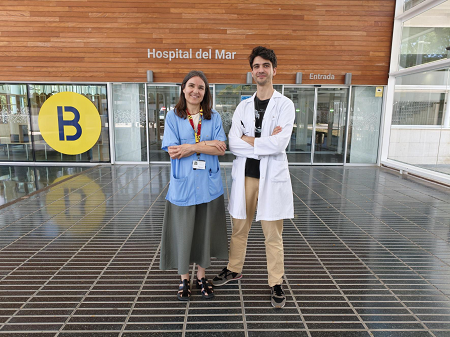
Imagen: Elisa Cuadrado and Joan Jiménez Baladó.
Reference article: Jiménez-Balado J, Arreaza-Baena M, Bakker MK, Ruigrok YM, Vallverdú-Prats M, Ois A, Macias-Gómez A, Fernández-Pérez I, Guisado-Alonso D, Rodriguez-Campello A, Giralt-Steinhauer E, Jiménez-Conde J, Bijlenga P, Morel S, Rezai Jahromi B, Niemelä M, Werring DJ, Hostettler IC, Cuadrado-Godia E. Genome-wide association study links COL6A6 and PIK3R4 to delayed cerebral ischaemia. Brain. 2026; awag188. https://doi.org/10.1093/brain/awag188

La mejor actitud que podemos adoptar es la de trat...

The research team observed changes in head circumf...
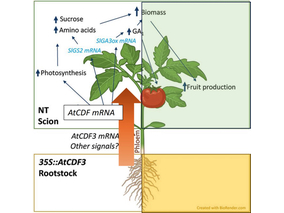
AtCDF3 gene induced greater production of sugars a...
En nuestro post hablamos sobre este interesante tipo de célula del...
A multicentre study led by researchers at the Hospital del Mar Researc...