A research group from the Spanish National Centre for Biotechnology (CNB-CSIC) has identified a novel function of the TRIM34 protein in interfering with the innate immune response to viral infections. The study, published in the journal PLOS Pathogens, shows how TRIM34 interacts with nuclear pore proteins, preventing the entry and exit of various factors necessary to amplify the antiviral response.
The innate immune system acts as the first line of defence against viral infections. The recognition of a virus triggers an intracellular signalling cascade to induce the production of pro-inflammatory cytokines and interferons; these signals, in turn, activate the production of new proteins with antiviral properties to control the infection. In this complex system, the TRIM protein family—comprising more than 80 identified proteins whose expression is induced by interferons—plays a key role, being capable of regulating a wide range of cellular processes, from autophagy to innate immune signalling and direct viral restriction.
Marta López de Diego, a CNB-CSIC researcher and lead author of the study, explains the rationale behind the research. “We decided to study TRIM34 because it is already known its function (and the mechanism) to regulate programmed cell death and tumour progression, but it is not known how it works in a viral infection at the molecular level.” To identify how TRIM34 might affect the infection, the researchers conducted experiments both in vitro, in various human cell lines, and in vivo, in mice. By temporarily increasing or decreasing TRIM34 levels, they analysed the evolution of influenza virus infection. They observed that TRIM34 levels modify the infection progress, but in an unexpected way. Instead of limiting viral replication, increased TRIM34 levels lead, in turn, to increased viral production and inhibition of the innate immune response.
Identifying the proteins that TRIM34 interacts with in this context provides a clue to the mechanism. As López de Diego explains, “TRIM34 binds to cellular proteins that form part of the nuclear pores, the entry and exit points for molecules responsible for signaling the processes that trigger the innate immune response”.
A blockage of internal transport with far-reaching effects
A significant part of the antiviral response begins with the induction of protein synthesis capable of halting the infection. Transcription factors are involved throughout this process; they enter the cell nucleus to induce the expression of genes that are normally inactive and are capable of blocking viral infection. The mRNAs produced by these genes are transported from the cell nucleus to the cytoplasm, where protein synthesis takes place. The transport of different types of molecules between the nucleus and the cytoplasm is critical, and this is where TRIM34 acts.
For the first time, the interaction of a protein from the TRIM family with the nuclear pore has been observed. According to Paula Vázquez Utrilla, researcher at the CNB-CSIC and first author of the study, “this interaction results in a blockade of the transcription factor IRF3 entry into the nucleus, and the inhibition of the exit of cellular mRNAs involved in the antiviral response into the cytoplasm. However, viral mRNAs continue to exit the nucleus and produce viral proteins. Whilst the initial aim of this cellular process may be to reduce the excessive production of pro-inflammatory cytokines, which are potentially harmful to the body, in the context of influenza infection it favours viral replication by inhibiting antiviral responses.”
These results suggest that modulating TRIM34 activity could constitute a promising strategy for antiviral treatment against influenza A virus (IAV) and, possibly, other viral infections. However, future studies must pay particular attention to the risk of exacerbating inflammation.
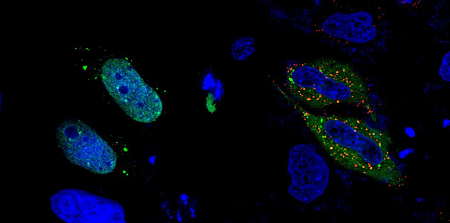
Image: Advanced optical microscopy showing the difference in the localisation of the transcription factor IRF3 (green) in cells with low (left) and high (right) levels of TRIM34 (red). The cell nucleus is shown in blue. When TRIM34 (red) increases, it interacts with IRF3 (yellow dots), preventing the latter from entering the cell nucleus. When TRIM34 (red) increases, it interacts with IRF3 (yellow dots), preventing the latter from entering the cell nucleus. Paula Vázquez, (CNB-CSIC)
Reference: Paula Vázquez-Utrilla, Vanessa Rivero, and Marta L. DeDiego. Tripartite motif containing 34 (TRIM34) protein interacts with the nucleocytoplasmic transport machinery and negatively modulates antiviral responses Plos Pathogens 2026 DOI: https://doi.org/10.1371/journal.ppat.1014142
CNB-CSIC Communication

La mejor actitud que podemos adoptar es la de trat...

The research team observed changes in head circumf...

AtCDF3 gene induced greater production of sugars a...

En nuestro post hablamos sobre este interesante tipo de célula del...
The UAB and the IMB-CNM have developed microdevices with piezoelectric...