The altered presence of tiny fragments of neuronal genes, known as microexons, causes hyperarousal in zebrafish. This is the main finding of an international study led by Pompeu Fabra University (UPF) and the Centre for Genomic Regulation (CRG). An abnormal pattern of neural microexon presence leads to a hyperarousal state, characterised by heightened neural activity and insomnia, commonly associated with stress but also with neurodevelopmental disorders. Arousal regulation is highly conserved in evolution. This finding could therefore help to understand the mechanism underlying some human neurodevelopmental disorders, such as autism and schizophrenia, conditions associated with microexon mutations.
To survive, animals need to be ready to react to external and internal stimuli. This activation of the central nervous system, called arousal, is highly conserved throughout the animal kingdom. Proper regulation of arousal ensures that neural and, thus, behavioural responses, maintain a balance between drowsiness or reduced responsiveness and insomnia and sensory hypersensitivity, two states associated with stress and neurodevelopmental disorders.
To properly regulate arousal during development and adulthood, organisms require a broad range of diverse proteins that are achieved via alternative splicing. This is a process that can produce two functionally distinct proteins with similar but not identical amino acid sequence, in response to the presence or absence of one or more microexons.
The study published in Science Advances shows that, in zebrafish, an alteration in the presence of neural microexons leads to a state of hyperarousal. Abnormal fish larvae have an altered swim pattern and reduced sleep. “They sleep less frequently, for shorter durations and take longer to fall asleep,” explains Tahnee Mackensen, first author of the study, who adds, “It is fascinating to see how, by analysing the movement of these transparent larvae, you can infer the internal states of fish.”
In addition to the behavioural alterations, researchers found that mis-splicing alters cAMP levels—a signal produced within cells that regulates neuronal activity—making them more or less excitable. “Abnormal fish are permanently overexcited,” clarifies Mackensen. They have increased activity in the forebrain and elevated cAMP signalling, responsible for the hyperactivity during the day. However, this hyperactivity can be normalised by manipulating cAMP pharmacologically.
According to the study, reducing cAMP with a chemical inhibitor lowers the activity of the mutated fish to a normal level, whereas maintaining elevated cAMP levels in normal fish using drugs—either by inducing its synthesis or reducing its degradation—mimics highly aroused behaviour, confirming that cAMP is key to driving arousal behaviour. Or, in the words of the scientist, “In neurons, cAMP acts as a thermostat for its activity.”
Study in zebrafish with a human angle
The constellation of behavioural and neuronal shifts observed in abnormal zebrafish had also been reported in flies in a previous study by the same group. “We do know that the alteration of these microexons causes sleep deprivation in fish and flies”, explains Manuel Irimia, who has led the research. He adds, “this mechanism is likely to be conserved in mammals, including humans, but maybe not in exactly the same way.”
In humans, sleep disturbances and sensory hypersensitivity are frequent in neurological disorders like autism and schizophrenia, two disorders that are reported to have altered microexon regulation.
“Despite not being causative of the disease, we know that changes in protein production can contribute to symptoms of the disorder,” acknowledges Irimia, leader of the Transcriptomics of Development and Evolution lab at UPF and CRG, who concludes, “In this sense, it is plausible to study whether the treatment to restore the arousal state in fish also corrects or alleviates the symptoms in other species.”
This cAMP-regulated arousal pathway is also implicated in anxiety and depression. That is why Mackensen believes it is worth continuing to investigate because, “this could be just the tip of the iceberg.”
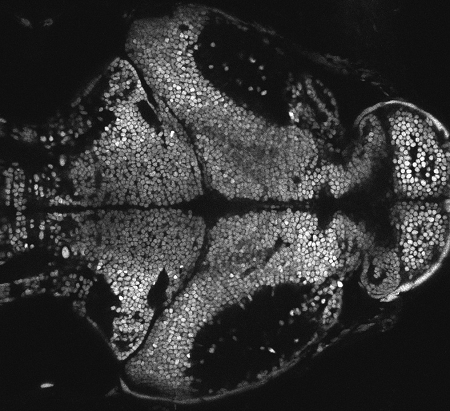
Image: Calcium levels in brain cells. A technique used to measure neural activity, with the most active cells being the brightest. Credit: UPF - CRG
About the study
This study has been developed within the ZENITH zebrafish Doctoral Network funded by the European Comission.
Mackensen, T; et al.; Neuronal microexons modulate arousal via the cAMP-PKA-CREB pathway in zebrafish; Science Advances, juny de 2026.

La mejor actitud que podemos adoptar es la de trat...

The research team observed changes in head circumf...
AtCDF3 gene induced greater production of sugars a...
En nuestro post hablamos sobre este interesante tipo de célula del...

Curapath is pleased to acknowledge the significant progress achieved b...