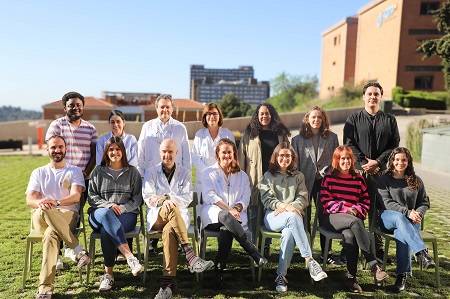
The Experimental Tuberculosis Unit (UTE) at the Germans Trias i Pujol Research Institute (IGTP) has published in Nature Communications the results of a phase IIa pilot clinical trial assessing ibuprofen as a host-directed therapy in patients with pre-extensively drug-resistant tuberculosis (pre-XDR-TB) and extensively drug-resistant tuberculosis (XDR-TB).
Drug-resistant tuberculosis remains one of the major global public health challenges. In addition to the difficulty of eliminating the bacterium, an excessive inflammatory response contributes to lung damage and to the long-term effects that may persist after microbiological cure. In this context, host-directed therapies seek to modulate the affected person's immune response in order to reduce disease-related damage and complement the action of established antibiotic treatment.
The study was coordinated by Dr Cristina Vilaplana, leader of the UTE research group, which is affiliated with the Microbiology Department at Germans Trias i Pujol University Hospital (HUGTIP). It was conducted at the National Center for Tuberculosis and Lung Diseases in Georgia and included 28 patients with pre-XDR-TB and XDR-TB, who received standard tuberculosis treatment with or without ibuprofen during the first two months of therapy.
The results show that adding ibuprofen to standard tuberculosis treatment was safe and well tolerated, without increasing adverse events. Although it was not associated with an improvement in the main clinical or microbiological outcomes, participants who received ibuprofen showed a greater reduction in several inflammatory markers and in molecular signatures associated with poorer tuberculosis outcomes.
According to the authors, these findings are exploratory and, although they do not demonstrate a clinical benefit, they indicate that ibuprofen has biological activity on the inflammatory response. Beyond its findings, the study represents the first clinical proof of concept for the use of ibuprofen as an adjunct to tuberculosis treatment.
The evidence generated was instrumental in the design and development of the international phase IIb clinical trial carried out within the European SMA-TB project, coordinated by IGTP and funded by the European Commission's Horizon 2020 programme. The trial assessed higher doses of ibuprofen and acetylsalicylic acid as adjunctive drugs to antibiotic treatment for tuberculosis in patients in South Africa and Georgia.
"Although this was a pilot trial involving a small number of patients, both the strengths and the limitations of the study have laid the foundations not only for the continued clinical development of ibuprofen, but also for the design of more robust studies assessing host-directed therapies as adjuncts to antibiotic treatment for tuberculosis. This approach is particularly relevant because it may contribute to the development of new strategies to combat infections caused by multidrug-resistant bacteria," explains Dr Vilaplana.
The publication of this study consolidates the leadership of IGTP and HUGTIP, as well as their Experimental Tuberculosis Unit, as international reference centres in the design, coordination and delivery of clinical trials evaluating new prophylactic and therapeutic strategies against tuberculosis. This work is underpinned by translational research covering the entire development pathway, from preclinical validation to the clinical assessment of new interventions, including host-directed therapies, vaccination strategies and other innovative approaches aimed at improving the prevention, treatment and prognosis of the disease.
The published article marks a further milestone in this translational trajectory and highlights the importance of pilot studies as a basis for launching larger international clinical trials and accelerating the development of new therapeutic strategies against tuberculosis.
Reference: Fonseca, K.L., Farrés, J., Barbakadze, K. et al. Adjunctive ibuprofen in pre-extensively drug-resistant and extensively drug-resistant tuberculosis: a phase IIA open-label pilot clinical trial. Nat Commun (2026). DOI: doi.org/10.1038/s41467-026-75148-9

La mejor actitud que podemos adoptar es la de trat...

The research team observed changes in head circumf...

AtCDF3 gene induced greater production of sugars a...

En nuestro post hablamos sobre este interesante tipo de célula del...

The positive outcomes have led to the launch of a new project, which w...