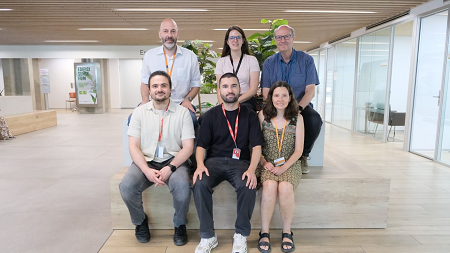
An international team of researchers with outstanding participation from the PADO group (Oncology Data Analytics Programme) of the Catalan Institute of Oncology (ICO) in L’Hospitalet and the Bellvitge Biomedical Research Institute (IDIBELL) has developed a new tool that could facilitate the early detection of pancreatic cancer, one of the most aggressive tumours and difficult to diagnose in time.. “The model is simple, non-invasive and low-cost, because it is mainly based on information on the main risk factors that can be easily collected through health and lifestyle questionnaires,” says Lois Riobo-Mayo, the first author of the study. This opens the door to using it as an accessible initial screening tool to detect cancer earlier that is often diagnosed late.
Thus, the study, published in the scientific journal International Journal of Epidemiology, has validated a scoring system based on 24 epidemiological factors – such as age, smoking, diabetes or family history – that allows people with a higher risk of developing pancreatic cancer to be identified before more complex tests such as MRIs or genetic tests are necessary.
Identify risk before it appears through epidemiological data
The work has been developed within the framework of the European project focused on people at high family risk of suffering from this disease. To confirm the robustness of the results, the researchers have validated them with data from almost 300,000 participants from the UK Biobank.
At this point, the ICO-IDIBELL team of researchers has played a central role in the development of the tool, the statistical analysis and the integration of epidemiological data. In fact, this team specialises in the use of big data and analytical intelligence applied to cancer.
According to the first author of the study and researcher at ICO and IDIBELL, Lois Riobo-Mayo, “the great challenge with pancreatic cancer is that it is often detected too late. With this tool we want to help identify the people most at risk earlier and make it easier for them to enter early follow-up programmes“.
A first filter for more efficient detection
The results show that people with higher scores were more likely to have suspicious lesions detected by MRI. This reinforces the tool’s potential as a first filter to select which people could benefit from more thorough medical monitoring.
Currently, mass screening for pancreatic cancer is not recommended because there are no tests effective enough to apply to the entire population. In this context, simple and accessible tools such as this one can help to focus efforts on the most at-risk groups and make early detection more efficient, which contributes directly to one of the main objectives of the Bellvitge Health Campus as a Comprehensive Cancer Centre (CCC): to move towards faster and more personalised diagnoses, also in the early detection of cancer.
Following the same line, the research team is now working to combine this epidemiological score with genetic data and biomarkers, with the aim of further improving the predictive capacity of the model and moving towards even more personalized medicine.

La mejor actitud que podemos adoptar es la de trat...

The research team observed changes in head circumf...

AtCDF3 gene induced greater production of sugars a...

En nuestro post hablamos sobre este interesante tipo de célula del...
The study analyses the role of PARP2 protein in tumour development and...