Every time a laboratory generates a molecular dynamics simulation, it accumulates several terabytes of data that, in most cases, is never consulted again. This is not because the data lacks value, but rather due to a lack of infrastructure to preserve and share it in a way that allows other groups to reuse it.
MD4SB (Molecular Dynamics for Structure-based Biology) is a new European project funded with €10 million by Horizon Europe and led by IRB Barcelona. It aims to integrate molecular dynamics data and tools into three major European Research Infrastructures: Instruct-ERIC, which specializes in structural biology; ELIXIR, in life sciences data; and EU-OPENSCREEN ERIC, in chemical biology and the screening of compounds with therapeutic potential.
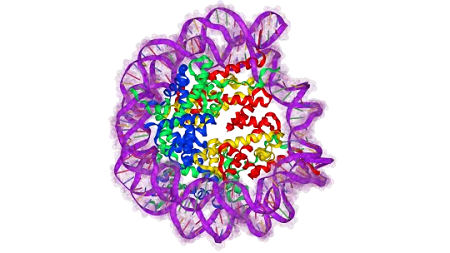
Molecular dynamics allows the simulation of how proteins and other biological molecules move, how they change shape, and how they interact with potential drugs. This information complements static structural images, which capture a single position, much like a photograph.
The challenge with this type of data is that it is highly complex, difficult to obtain, and requires significant storage and computational capacity, as well as tools that allow it to be shared with other groups. This prevents massive computational efforts from being lost due to an inability to re-analyse them.
MD4SB builds upon the previous work of MDDB (Molecular Dynamics Data Bank), which developed a distributed platform to store and share large volumes of molecular dynamics data following the FAIR principles: data must be Findable, Accessible, Interoperable, and Reusable.
"Now, for the first time on a European scale, MD4SB will integrate this technology into major infrastructures and put it at the service of structural biology, artificial intelligence, and drug discovery," explains Dr. Modesto Orozco, head of the Molecular Modelling and Bioinformatics laboratory at IRB Barcelona, professor at the University of Barcelona, founder of the biotech company Nostrum Biodiscovery, and coordinator of the MD4SB project.
MD4SB will integrate its tools into three major European infrastructures covering complementary phases of biomedical research: the structural characterization of proteins, the management and reuse of scientific data, and the identification of compounds with therapeutic potential.
To make this possible, the project will also rely on supercomputing centres and AI Factories, which will provide large-scale computing, storage, and analysis capabilities. This combination will connect molecular dynamics with new artificial intelligence applications. It will also ensure that data generated by simulations can be reused across different scientific contexts, rather than remaining trapped on local servers without access for other groups.
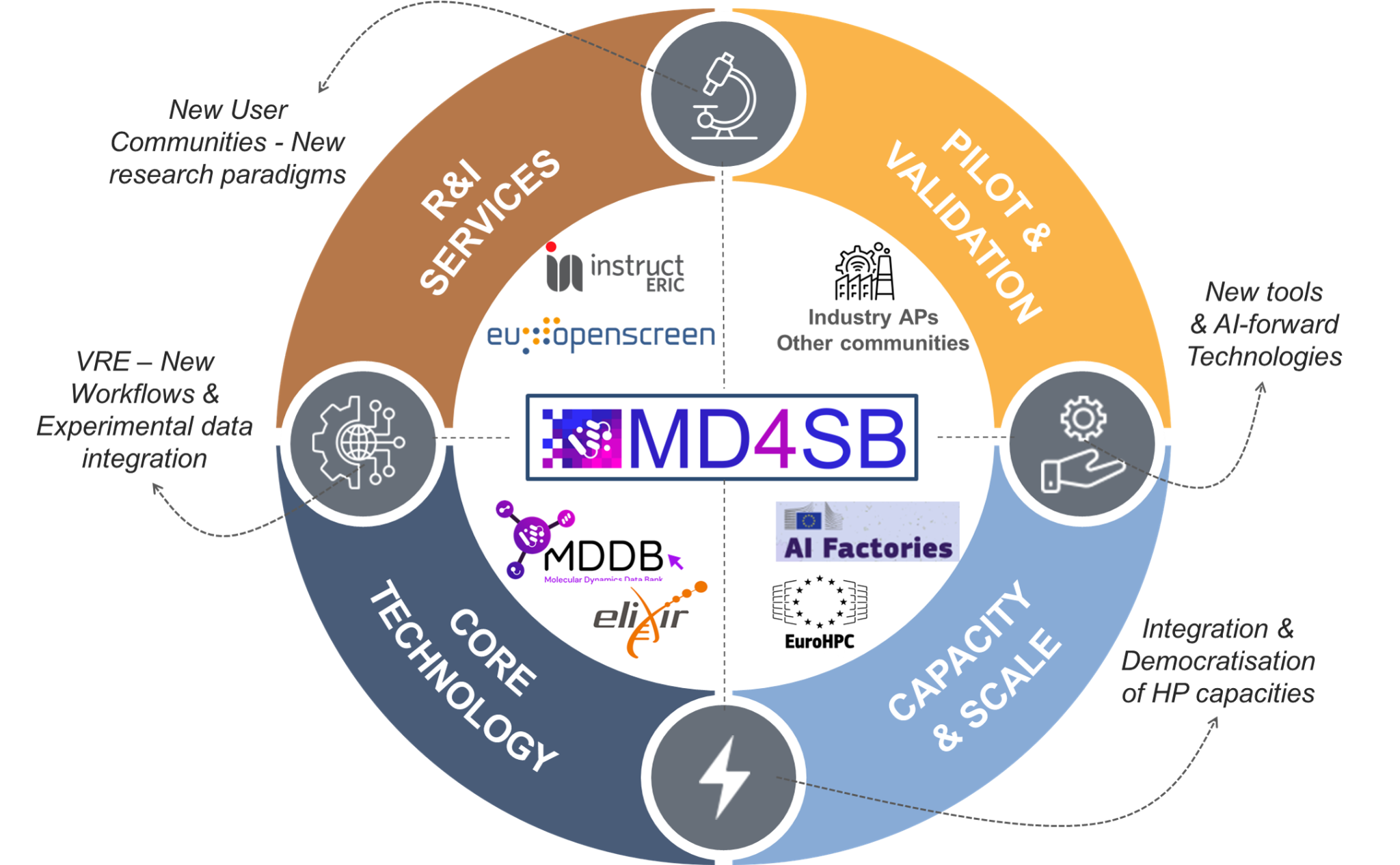
MD4SB as a central hub for EU-RIs, AI factories, and the biotech and pharmaceutical industry.
One of the primary goals of MD4SB is to accelerate the early stages of drug discovery. Molecular dynamics simulations allow researchers to observe how proteins move and to detect regions that do not appear in static structures, yet may be key to designing new compounds.
The pharmaceutical industry will play an active role in the project. Almirall and Sanofi, among others, will participate as associate partners and will provide feedback and evaluate the practical usefulness of the platform in real-world industrial research environments, ensuring that the developed tools meet the specific needs of both academia and industry. Nostrum Biodiscovery, an IRB Barcelona and Barcelona Supercomputing Center - Centro Nacional de Supercomputación (BSC-CNS) spin-off, will act as a facilitator to help companies utilize this technology.
"We want molecular dynamics to become a shared capability for the European scientific community because it can accelerate and expand the scope of many research projects," notes Dr. Orozco.
MD4SB will be launched on 1 September 2026 and will span four years. The consortium brings together 25 partners from 8 countries: academic centres, European Research Infrastructures, supercomputing centres, biotech, and pharmaceutical companies.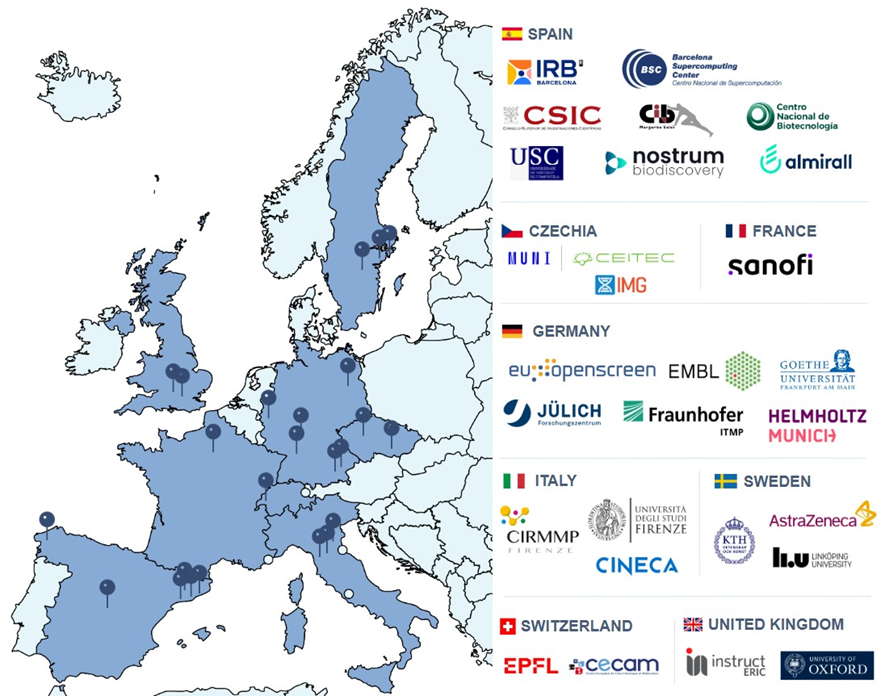
MD4SB Consortium: 25 partners across 8 countries.
While Europe has well-established research infrastructures, molecular dynamics is still used in a fragmented manner, concentrated within highly specialized groups. MD4SB seeks to change this by expanding the capabilities of existing infrastructures and bringing advanced molecular data within reach of academic research and the European pharmaceutical and biotech industries.
About IRB Barcelona
The Institute for Research in Biomedicine (IRB Barcelona) pursues a society free of disease. To this end, it conducts multidisciplinary research of excellence to cure cancer and other diseases linked to ageing. It establishes technology transfer agreements with the pharmaceutical industry and major hospitals to bring research results closer to society, and organises a range of science outreach activities to engage the public in an open dialogue. IRB Barcelona is an international centre that hosts 400 researchers and more than 30 nationalities. Recognised as a Severo Ochoa Centre of Excellence since 2011, IRB Barcelona is a CERCA centre and member of the Barcelona Institute of Science and Technology (BIST).

La mejor actitud que podemos adoptar es la de trat...

The research team observed changes in head circumf...
AtCDF3 gene induced greater production of sugars a...
En nuestro post hablamos sobre este interesante tipo de célula del...
Un estudio liderado por la URV, el IRB-CatSud y el CIBEROBN identifica...