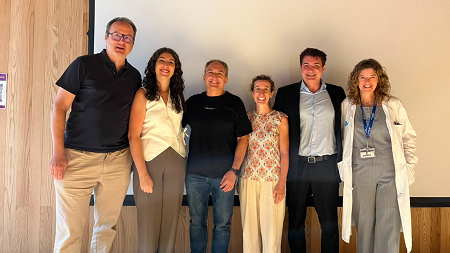
Understanding how alterations in a protein involved in neuronal connections can lead to involuntary movements, dystonia, and psychiatric symptoms was the focus of the doctoral thesis defended by Dr. Ana Laura Cazurro Gutiérrez, a researcher with the Molecular Physiology of the Synapse Group at the Sant Pau Research Institute (IR Sant Pau). The thesis, titled «Molecular, Cellular and Clinical Research on ε-Sarcoglycan Broadens the Pathophysiological Landscape of SGCE-Myoclonus Dystonia», integrates molecular, cellular, experimental, and clinical research to expand knowledge of this rare disease, its progression, and its treatment possibilities.
The project was carried out through a collaboration between IR Sant Pau, through the Molecular Physiology of the Synapse Group led by Dr. Àlex Bayés, and the Vall d’Hebron Research Institute (VHIR), through the Therapies and Innovation in Pediatric Neurology Group led by Dr. Belén Pérez. Both researchers supervised Dr. Cazurro’s thesis.
The thesis was evaluated by a committee with a strong clinical and international profile. Its members included Dr. Emmanuel Roze, a neurologist at Pitié-Salpêtrière Hospital in Paris and Professor of Neurology at Sorbonne University, who specializes in movement disorders, particularly in pediatric populations, and in the study of their clinical, genetic, and neurophysiological foundations. The committee also included Dr. Eduard Gallardo Vigo, an IR Sant Pau researcher in the Neuromuscular Diseases Laboratory, and Dr. Ana Roche Martínez, a pediatric neurologist in the Pediatric Neurology Unit at Parc Taulí University Hospital.
SGCE-associated myoclonus-dystonia usually begins during childhood and is characterized by myoclonus—brief, rapid, involuntary muscle movements—and dystonia, which can cause muscle contractions and abnormal postures. Psychiatric manifestations such as anxiety and obsessive-compulsive disorder are also common.
“The disease has traditionally been studied mainly from the perspective of its motor manifestations, but its impact is broader. The thesis has allowed us to connect what happens at the molecular and cellular levels with the motor, cognitive, and psychiatric symptoms observed in patients,” explains Dr. Cazurro.
The Role of ε-Sarcoglycan at Synapses
One of the main objectives of the thesis was to investigate the role of ε-sarcoglycan in the brain. This protein is encoded by SGCE. The results show that its expression varies throughout brain development and adulthood, suggesting that it may perform different functions at different stages of life.
The study also identified extensive alternative processing of SGCE in the human brain, a mechanism that makes it possible to generate different versions, or isoforms, of a protein and that could help explain its functional complexity.
In a mouse model deficient in Sgce, the researchers detected changes in synaptic morphology, particularly in the somatosensory cortex. These changes were associated with motor deficits, increased anxiety- and compulsivity-related behaviors, and memory impairment.
The findings support a model in which ε-sarcoglycan is involved in the formation and maintenance of neuronal connections. Its absence could affect integrative brain regions and extend dysfunction to networks involved in movement, cognition, and emotions.
“The alterations observed do not appear to be limited to an isolated motor circuit. This may help us understand why the same genetic alteration can lead to such diverse clinical manifestations,” the researcher notes.
Clinical Progression and Deep Brain Stimulation
From a clinical perspective, the thesis shows that symptoms generally begin during childhood and may progress during adolescence, with worsening motor manifestations, particularly in the upper limbs. The high prevalence of psychiatric symptoms reinforces the need for multidisciplinary follow-up that also considers their impact on independence, learning, and family and social life.
The research also evaluates the effectiveness of deep brain stimulation of the globus pallidus internus in pediatric patients. The results show a significant and sustained improvement in motor symptoms, indicating that some dysfunction affecting brain circuits may be modifiable.
These findings support considering this therapeutic option for carefully selected patients and underscore the importance of determining the most appropriate time to propose it when symptoms severely impact independence and quality of life.
“A more profound understanding of disease progression can help us anticipate patients’ needs and make clinical decisions at the most appropriate time. The response to deep brain stimulation also shows that some altered circuits retain the capacity to be modulated,” Cazurro concludes.
Overall, the thesis expands current knowledge of the role of ε-sarcoglycan and suggests that its deficiency may disrupt synaptic integrity and impact motor, cognitive, and emotional networks. The integration of basic and clinical research provides a more comprehensive view of SGCE-associated myoclonus-dystonia and opens new avenues for improving its monitoring and treatment.

La mejor actitud que podemos adoptar es la de trat...

The research team observed changes in head circumf...
AtCDF3 gene induced greater production of sugars a...
En nuestro post hablamos sobre este interesante tipo de célula del...
Un estudio liderado por la Universidad de Sevilla y el Centro de Inves...