Red Fluorescent Dye for Advanced Super-Resolution Microscopy
Visualising biological structures at the nanoscale demands fluorescent probes that deliver exceptional brightness and stability under intense illumination. However, many conventional dyes suffer from photobleaching and signal loss, limiting image quality and experimental reproducibility.
Key Challenges
Super-resolution microscopy techniques such as STED, PALM, STORM and GSDIM require fluorophores that maintain strong fluorescence signals throughout long acquisition periods while enabling precise localisation of molecular targets.
Overview
abberior CAGE 552 is a high-performance caged rhodamine dye engineered for advanced super-resolution imaging applications. Initially colourless and non-fluorescent, it undergoes irreversible UV-induced photolysis (360–440 nm) to generate a bright red fluorophore with emission around 575 nm.
This controlled photoactivation enables precise visualisation of cellular structures, supports high-resolution localisation microscopy workflows, and delivers the brightness and photostability required for demanding techniques such as STED, PALM, STORM and GSDIM.
Key Benefits
Key Features
Typical Applications
Why Choose Abberior CAGE 552?
Researchers working with demanding super-resolution techniques require fluorophores that combine brightness, stability and precise photoactivation. Abberior CAGE 552 delivers all three, supporting reliable data acquisition and enabling the visualisation of biological processes at unprecedented resolution.
Quick Takeaway
A UV-activatable red fluorescent dye designed for super-resolution microscopy, delivering outstanding brightness, photostability and localisation precision for advanced biological imaging.
Available as part of a broad portfolio of colours for flexible multicolour super-resolution imaging workflows.
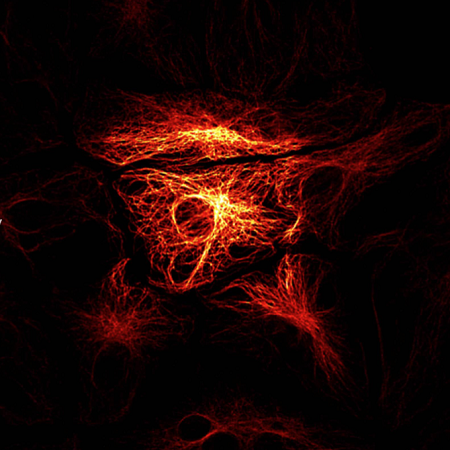
Imagen: abberior CAGE 552 is a caged dye which is initially nonfluorescent and colorless substance which, upon photolysis with UV light, readily transforms irreversibly into a red and highly fluorescent dye. The cytoskeleton is visible after UV induced uncaging of abberior CAGE 552. (Image from Abberrior).

La mejor actitud que podemos adoptar es la de trat...

El equipo de investigadores observó cambios en el...

El gen AtCDF3 promueve una mayor producción de az...

En nuestro post hablamos sobre este interesante tipo de célula del si...
Desarrollan un nuevo enfoque basado en la fotofarmacología, que permi...