These bio-inspired soft robotic devices could offer many more capabilities for movement and performance – such as real-time bio-sensing, self-organization, adaptability, or self-healing – than existing systems, which use solely artificial materials.
“Bio-inspired soft robotics is an exciting new discipline, as it may help us overcome the limitations of traditional robotic systems, such as flexibility, responsiveness and adaptability,” says Samuel Sanchez, group leader at IBEC and ICREA research professor.
“We’re exploring the potential of 3D bioprinting to make even better ones, because it offers speed, ease of design, shape and materials customisation and scalability options.”
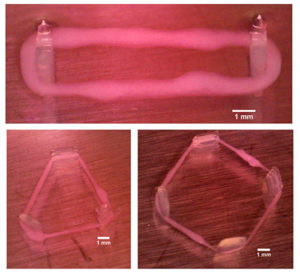
The group used 3D bioprinting to make bio-actuators with highly aligned myotubes, the multi-nucleated fibers necessary for functional muscle. To be able to gauge the forces of the actuators, they were constructed with artificial posts (pictured above: the pink rings are the printed muscles) to form a measuring platform. The researchers also studied the gene expression of the bio-actuators to evaluate their adaptability to exercise training.
“We found them to be functional and responsive, and the forces they generate can be modulated according to different requirements,” says Tania Patiño, corresponding author of the paper published in Advanced Mat. Technologies today. “We now know much more about the fundamental mechanisms behind the adaptability of muscle-based bio-actuators, and that 3D bioprinting is successful as a rapid and cost-effective method for making them.”
“We’ve shown that this integration of biological systems into robotic devices provides them with capabilities acquired from natural systems and significantly boosts their performance,” adds Rafael Mestre, a PhD student in the group and first author of the paper. “It could be the key to being able to develop soft robotic devices able to grasp, walk, or perform other simple actions.”
—
Rafael Mestre, Tania Patiño, Xavier Barceló, Shivesh Anand, Ariadna Pérez-Jiménez, Samuel Sánchez (2018). Force Modulation and Adaptability of 3D‐Bioprinted Biological Actuators Based on Skeletal Muscle Tissue. Advanced Mat. Technologies, early view

La mejor actitud que podemos adoptar es la de trat...

The research team observed changes in head circumf...
AtCDF3 gene induced greater production of sugars a...
En nuestro post hablamos sobre este interesante tipo de célula del...
New study finds an association between higher temperatures early in li...