A new study led by researchers at the National Centre for Biotechnology (CNB-CSIC), part of the Spanish National Research Council (CSIC), has investigated a potential strategy to reduce the invasive behaviour of metastatic breast cancer cells through the use of iron oxide nanoparticles. Conducted under in vitro conditions using cultured cells, the research focuses on the role of oxidative stress as a mechanism to interfere with tumour progression.
The study, published in the Journal of Nanobiotechnology (BMC Springer Nature), was carried out using the MDA-MB-231 cell line, a widely used model for studying particularly aggressive forms of breast cancer. These cells are especially sensitive to disruptions in their redox balance — the cellular system responsible for maintaining equilibrium between the production and neutralisation of reactive oxygen-derived molecules. When this balance is disturbed, oxidative stress occurs, potentially altering cellular components and impairing their function.
In this work, the researchers used iron oxide nanoparticles coated with DMSA, a biocompatible coating agent previously identified by the group as the most effective at inducing oxidative stress in tumour cell lines. The results show that exposure to these nanoparticles increases oxidative stress within the cells and significantly reduces their ability to migrate and invade other tissues.
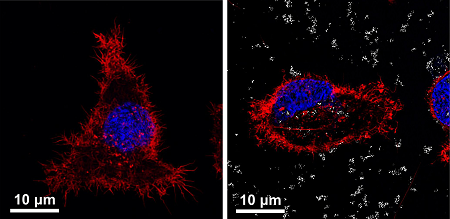
One of the most striking effects observed involved the actin cytoskeleton, a network of filaments that gives cells their shape and enables movement. Oxidative stress altered the organisation of this structure, leading to visible changes: the cells became smaller and more compact, actin accumulated at the cell periphery (the cell cortex), and the formation of key structures involved in movement and interaction with the surrounding environment was reduced. These structures include invadosomes, which help degrade tissue surrounding the tumour, and lamellipodia, membrane protrusions that drive cell migration. “These changes directly affect the ability of tumour cells to reorganise their internal structure and migrate, a fundamental process in tumour dissemination,” explains Domingo F. Barber, CSIC researcher at CNB-CSIC and lead author of the study.
Beyond these structural effects, the study also found that the nanoparticles accumulate within intracellular compartments known as endolysosomal vesicles, which act as cellular “processing and recycling centres”. “This accumulation disrupts intracellular vesicle trafficking, namely the mechanisms by which the cell transports and secretes proteins and other molecules,” Barber adds.
More specifically, the researchers observed reduced release of lysosomes and autophagosomes — structures involved in cellular degradation and recycling — alongside increased release of multivesicular bodies. “This suggests that nanoparticle treatment alters cellular secretion pathways and promotes the release of extracellular vesicles (EVs), small structures that cells use to communicate within the tumour microenvironment,” says Neus Daviu, also a researcher at CNB-CSIC and lecturer at Universidad Francisco de Vitoria (UFV). “Extracellular vesicles are a key means of communication between cells, and these findings suggest that nanoparticle treatment may be reshaping that communication,” Daviu adds.
The researchers also examined how these changes affect endothelial cells, which are responsible for forming blood vessels. They found that when endothelial cells were exposed to signals released by tumour cells previously treated with nanoparticles, their ability to migrate and respond to chemical guidance cues (chemotaxis) was reduced. The endothelial cells also showed lower metabolic activity, although their viability remained unaffected. These findings suggest that treating tumour cells can influence the behaviour of surrounding cells through changes in the signals they release.
Taken together, the results indicate that modulating redox balance and vesicle trafficking using nanoparticles could represent a promising approach to slowing the metastatic spread of breast cancer. On the one hand, increased oxidative stress reduces the migratory capacity of tumour cells. On the other, changes in vesicle trafficking and extracellular vesicle release alter communication between tumour cells and their environment, influencing how they interact with surrounding cells within the tumour microenvironment.
Overall, these effects point to a dual mechanism of action: limiting tumour cell movement while simultaneously modifying the signalling processes through which tumour cells interact with neighbouring tissues. Further studies, however, will be needed to assess the potential clinical relevance of this strategy.
Image: Advanced optical microscopy image: untreated metastatic breast cancer cells (left) and cells following treatment with iron oxide nanoparticles (right). Filamentous actin (F-actin) is shown in red, cell nuclei in blue and nanoparticles in white. Treated cells appear smaller and display increased actin accumulation at the cell periphery, reflecting structural changes associated with reduced motility. / Neus Daviu. (CNB-CSIC).
Reference: Neus Daviu, Carla Graciano-Casero and Domingo F. Barber. Oxidative stress induced by DMSA-IONPs impairs breast cancer cell migration and paracrine cell communication. Journal of Nanobiotechnology (Springer). DOI: https://doi.org/10.1186/s12951-026-04412-3
CNB-CSIC Communication

La mejor actitud que podemos adoptar es la de trat...

The research team observed changes in head circumf...
AtCDF3 gene induced greater production of sugars a...
En nuestro post hablamos sobre este interesante tipo de célula del...

New study finds an association between higher temperatures early in li...