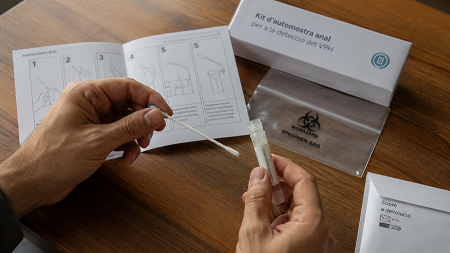
Anal self-sampling is an accurate, viable, and well-accepted tool for detecting and genotyping human papillomavirus (HPV) among men who have sex with men and trans people. This is the conclusion reached by a new multicenter study led by CEEISCAT (Center for Epidemiological Studies on Sexually Transmitted Infections and AIDS of Catalonia) and the Infections and Cancer group of IDIBELL-ICO, validating this strategy in real conditions. The results show that the samples collected by the participants themselves offer results comparable to those collected in the consultation: the overall concordance between the two is 96%.
The results, within the aSELF-GEN study, are published in the Journal of Medical Virology, and evaluate not only the concordance between anal self-samples and samples obtained by health professionals for HPV genotyping, but also the acceptability of the procedure among the participants. Thus, beyond corroborating the reliability of self-sampling as a screening tool, the study shows that it is a more accessible strategy that is highly valued by those who would be users: “Most participants valued self-sampling as a simple, acceptable and satisfactory method,” says Dr. Sònia Paytubi, researcher at IDIBELL-ICO and co-author of the study.
A 96% concordance between self-sample and clinical sampling
The study was carried out in three HIV units of three hospitals in the metropolitan area of Barcelona (Germans Trias i Pujol University Hospital, Vall d’Hebron University Hospital and Bellvitge University Hospital) and included 151 participants. The results show a high overall concordance of 96.0% between the two collection methods, with a sensitivity of 96.4% (detects almost all positive cases) and a specificity of 90.9% (correctly discriminates most negative cases) for the global detection of HPV. “The good concordance observed between the self-sample and the sample taken by professionals shows that this strategy can be a reliable alternative to facilitate access to HPV screening in populations exposed to higher risk,” says Dr. Cristina Agustí, co-author of the study and researcher at CEEISCAT.
Along the same lines, Dr. Paytubi stresses that “the anal samples collected by the participants correctly identify the vast majority of infections and offer results very similar to those obtained in the doctor’s office, in addition to being stable in conditions that allow flexible use outside the clinical environment”.
More accessibility to cancer screening and prevention
Beyond technical results, the work points to a paradigm shift in access to diagnosis. Self-sampling would allow part of the process to be moved outside the doctor’s office, expanding access to screening and helping overcome barriers, such as stigma or discomfort, associated with conventional clinical tests.
This innovation would be especially relevant in key populations at increased risk of HPV-associated squatous anal carcinoma, and shows how new screening strategies can have a direct impact on cancer prevention.
In this context, the aSELF-GEN study lays the groundwork for the deployment of TESTATE Papi, an online tool aimed at screening for dysplasia and anal cancer in men who have sex with men and trans people living with HIV. The work also shows that the samples remain stable even at elevated temperatures, making them easier to mail and expanding their potential for use outside the hospital setting.
Overall, the results support the incorporation of anal self-sampling as a complementary strategy in future programs and recommendations for anal HPV screening in populations exposed to higher risk.
The result of a collaboration between leading institutions
This study has been led by professionals from the Centre for Epidemiological Studies on Sexually Transmitted Infections and AIDS of Catalonia (CEEISCAT) of the Department of Health – and also a research group from the Germans Trias i Pujol Research Institute (IGTP) – and the Catalan Institute of Oncology (ICO) and the Bellvitge Biomedical Research Institute (IDIBELL).
The School of Public Health Pasteur-Cnam (Paris, France), the Department of Paediatrics, Obstetrics and Gynaecology and Preventive Medicine of the Autonomous University of Barcelona, the Centre for Biomedical Research in Epidemiology and Public Health Network (CIBERESP), the Carlos III Health Institute, the HIV and STI Unit (Infectious Diseases Service) of the Bellvitge University Hospital have also participated in the study. the Department of Infectious Diseases, the Fight AIDS Foundation of the Germans Trias i Pujol Hospital and the STI and HIV Unit Astilleros–Vall d’Hebron of the Vall d’Hebron University Hospital.

La mejor actitud que podemos adoptar es la de trat...

The research team observed changes in head circumf...
AtCDF3 gene induced greater production of sugars a...
En nuestro post hablamos sobre este interesante tipo de célula del...
The PHOENIX project, involving 13 European institutions, will evaluate...