American researcher Todd O. Yeates is taking part in the latest edition of Fundación Occident Visiting Researchers Programme at the Spanish National Cancer Research Centre (CNIO).
In his laboratory at the University of California, Los Angeles (United States), over two decades ago, Yeates began designing symmetrical protein nanoparticles – tiny ‘building blocks’ that self-assemble in the laboratory into proteins with the desired shape and function.
“The idea was to create components that would enable protein architecture to be built,” says Yeates. These protein nanoparticles are used in a variety of research fields: to deliver drugs to their target sites within the body, to develop vaccines or to visualise proteins so small that they are undetectable even under the most powerful microscopes.
Visualising target proteins for anticancer drugs
Many proteins involved in cancer are small and difficult to see under a microscope. Roger Castells-Graells, now a researcher at CNIO, combined Yeates’ protein nanoparticle technology with cryo-electron microscopy, making it easier to study proteins for which promising compounds in cancer research are currently being developed.
Castells-Graells transformed the artificial nanoparticles into megastructures capable of binding smaller proteins, forming part of a larger scaffold that is easier to visualise. This has made it possible, for example, to observe how certain drugs interact with their target proteins, which is essential when optimising drug design. He achieved this as a postdoctoral researcher at Yeates’s lab in California.
Castells-Graells came back to Spain as part of the Building the AI Generation programme, within the Generation D initiative, promoted by Red.es, and joined CNIO as leader of the Biomolecular Design and Structural Nanomedicine Group within CNIO’s Structural Biology programme. Now Castells-Graells wants “to incorporate this technology and make CNIO a pioneering institution in Spain in combining it with artificial intelligence for protein design,” he says.
“It’s so exciting I’m finding it hard to sleep”
Thanks to Fundación Occident Visiting Researchers programme, Castells-Graells will be hosting his former supervisor at CNIO for a number of visits over the coming months, in the belief that their collaboration will help accelerate progress in this convergence of technologies.
Their collaboration has already borne fruit in the first few weeks of work: based on the results obtained, they have written a paper together which is currently under review.
“Todd has sparked enthusiasm throughout the group, and among other groups in the programme,” says Castells-Graells. “I want to spend every minute he’s here with him, because we have so many plans.” It’s so exciting I’m finding it hard to sleep these days.”
Yeates and Castells-Graells will also be collaborating with CNIO’s Experimental Therapies Programme, “to see whether our technology can assist in the development of nanoparticles targeting proteins involved in prostate cancer.”
Fundación Occident and CNIO
The Fundación Occident Visiting Researchers programme funds research stays at CNIO for researchers who have developed their career at prestigious international centres over the past five years. These visits allow the host research group to forge bonds with the researcher’s centre, enabling new avenues of work to be initiated through the exchange of ideas and common interests.
Collaboration between Fundación Occident and CNIO dates back to 2009. Through this programme, CNIO has hosted David Goldgar; Rama Khokha; Mercedes Rincón; Astrid Laegreid; Maria Sibilia; Robert Benezra; Peter Petzelbauer; André Nussenzweig; Stephan A. Hahn; Patrick Sung; Chaitanya R. Divgi; Marcin Nowotny; Madalena Tarsounas; Raúl Rabadán; Wolfgang Weninger; Scott Lowe; Sonia Laín; Eva Nogales, Raul Mostoslavsky, Albana Gatelli, Gonçalo Bernardes, Yardena Samuels and Todd Yeates.
Biography of Todd Yeates
After completing his PhD at the University of California, Los Angeles (UCLA) with a thesis on X-ray crystallography methods, Yeates moved to the Scripps Research Institute to undertake postdoctoral research on viral capsids, the protein shell structures that protect the genetic material of viruses. After completing his studies, he returned to UCLA, where he set up his laboratory for structural, computational and synthetic biology within the Department of Chemistry and Biochemistry. There, he studied the large protein complexes found in nature and pioneered the design of protein nanoparticles, which are now used in various fields of research. Working towards this same end, his laboratory has also made progress in computational genomics.
About CNIO
The National Cancer Research Centre (CNIO) is a public research centre under the Department of Science, Innovation and Universities. It is the largest cancer research centre in Spain and one of the most important in Europe. It includes around five hundred scientists, along with support staff, who are working to improve the prevention, diagnosis and treatment of cancer.
About Fundación Occident
Fundacion Occident is a private non-profit organisation founded in 1998 by GCO (Grupo Catalana Occidente) in memory of Jesús Serra Santamans, a renowned entrepreneur and patron, who founded the insurance group. The foundation has five areas of action that structure its activity: Research, Enterprise and teaching, Social action, Sports, and Promotion of the arts. Within the area of research, its work focuses on channelling patronage and sponsorship activity that the Group has been carrying out for more than half a century, promoting its own research awards that recognise the achievements of young Spanish scientists in the areas of food and nutrition.
It also promotes programmes that bring the knowledge of international scientific experts to Spanish research groups, and other collaborations to promote scientific progress in cardiovascular and cancer research.
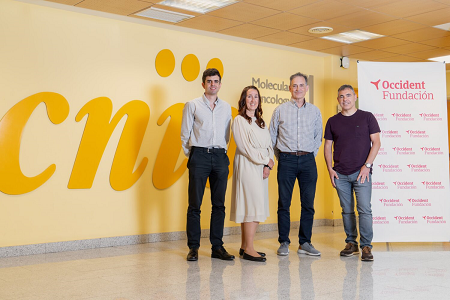
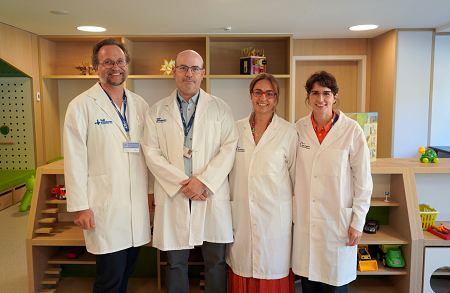
Image: From the left: Roger Castells-Graells, Susana Codina, deputy director at Fundación Occident, Todd Yeates and Óscar Llorca. / Christian Esposito. Madmoviex. CNIO

La mejor actitud que podemos adoptar es la de trat...

The research team observed changes in head circumf...
AtCDF3 gene induced greater production of sugars a...
En nuestro post hablamos sobre este interesante tipo de célula del...
The PHOENIX project, involving 13 European institutions, will evaluate...