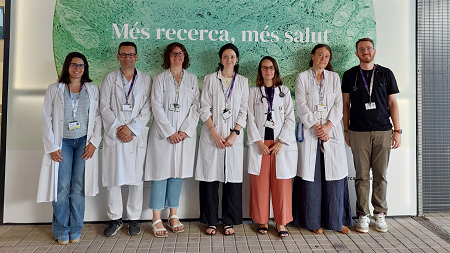
The direct analysis of human heart tissue from transplant recipients will enable a team at the Sant Pau Research Institute (IR Sant Pau) to gain deeper insight into the molecular mechanisms of dilated cardiomyopathy, one of the leading causes of advanced heart failure and a frequent indication for heart transplantation. The project, led by Dr. Marta de Antonio, a researcher in the Clinical and Translational Cardiology Research Group at IR Sant Pau, has received a research grant from the Catalan Society of Cardiology (SCC) to study how alterations in gene activity contribute to the development and progression of this disease.
Dilated cardiomyopathy is characterized by enlargement of the heart and deterioration of its pumping capacity. Although between 30% and 40% of cases have an identifiable genetic cause, there is still considerable clinical heterogeneity among patients, and genetic studies often detect variants whose pathogenic significance remains uncertain. Understanding the molecular mechanisms underlying these differences is one of the major current challenges in this area of cardiology.
“Dilated cardiomyopathy continues to raise numerous questions from a molecular and genetic perspective. This project allows us to study the affected heart tissue directly to better understand the mechanisms involved in disease progression,” explains Dr. Marta de Antonio.
Beyond Genetics: The Information Stored in Heart Tissue
The research project, titled “Transcriptomic Characterization of Heart Tissue to Identify New Pathogenic Mechanisms and Resolve Variants of Uncertain Significance in Dilated Cardiomyopathy,” will use advanced transcriptomic analysis techniques to directly study human heart tissue from patients who have undergone heart transplantation. The aim is to characterize the myocardial gene expression profile and identify altered genes and molecular pathways that may help improve understanding of the disease’s pathophysiology.
In addition to identifying molecular alterations associated with dilated cardiomyopathy, the project will explore imbalances in allele-specific expression and other transcriptomic alterations that could provide functional evidence for reinterpreting genetic variants of uncertain significance previously detected in patients. Integrating clinical, genetic, and transcriptomic information will provide a much more comprehensive view of the mechanisms involved in the disease.
“One of the most important aspects of the study is that we will be able to integrate clinical, genetic, and transcriptomic information from very well-characterized patients. This may help us interpret genetic variants whose significance remains uncertain and move toward more accurate diagnoses,” the researcher notes.
A Unique Cohort of Patients and Heart Tissue Samples at Sant Pau
One of the project’s main distinguishing features is that it is based on the direct analysis of human heart tissue explanted during heart transplantation, an approach that remains relatively uncommon in this field. Unlike many transcriptomic studies conducted using blood samples, this research will make it possible to analyze the affected organ directly and correlate the molecular alterations observed with each patient’s clinical and genetic characteristics.
The research will draw on an already characterized clinical cohort of patients with dilated cardiomyopathy treated at Sant Pau. The team currently has approximately 40 preserved heart tissue samples available for the study, obtained from hearts explanted at the time of transplantation, together with detailed clinical information and previous genetic studies. This combination of biological samples and clinical data provides an exceptional basis for gaining more profound insight into the molecular causes of the disease.
“Having access to human heart tissue samples from transplant recipients represents a highly valuable opportunity for research. In the future, this type of approach could help improve risk stratification and support progress toward more personalized medicine for cardiomyopathies,” adds Dr. de Antonio.
The project will be carried out entirely at Sant Pau and will combine the expertise of specialists in heart failure, cardiomyopathies, and cardiovascular genetics. RNA extraction will be performed in collaboration with the National Center for Genomic Analysis, while the sequencing and bioinformatic analysis of the transcriptomic data will be conducted at the Genomic Medicine Unit at IR Sant Pau.
The project will be carried out entirely at Sant Pau and will be co-led by cardiology and genetics professionals, combining clinical expertise in heart failure and cardiomyopathies with specialized knowledge in cardiovascular genetics and genomic analysis. The sequencing and bioinformatic analysis of the transcriptomic data will be conducted at the Genomic Medicine Unit at IR Sant Pau, while the technical aspects related to transcriptomic analysis will be defined as the project progresses.
The results could help improve understanding of the molecular basis of dilated cardiomyopathy, facilitate the interpretation of certain genetic alterations, and lay the groundwork for future strategies involving diagnosis, risk stratification, and personalized medicine for patients with this disease.

La mejor actitud que podemos adoptar es la de trat...

The research team observed changes in head circumf...
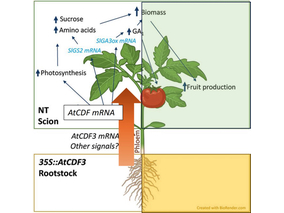
AtCDF3 gene induced greater production of sugars a...
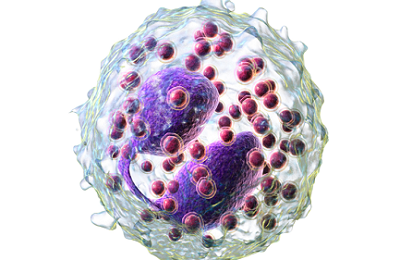
En nuestro post hablamos sobre este interesante tipo de célula del...
The direct analysis of human heart tissue from transplant recipients w...