Understanding the Ubiquitination Mechanism
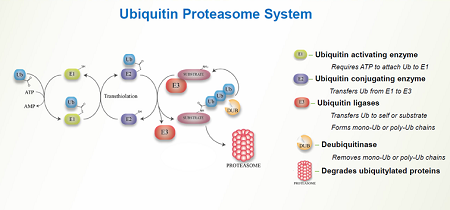
Ubiquitination is a reversible post-translational modification that regulates protein stability, signaling, trafficking, immune responses, DNA repair, and degradation. This process relies on a three-enzyme cascade (E1, E2, E3), which attaches mono- or poly-ubiquitin chains onto target substrates. These chains function as molecular signals that determine a protein’s fate (Main Image).
TUBEs: Tandem Ubiquitin Binding Entities
|
TUBEs are high-affinity “ubiquitin traps” engineered with multiple ubiquitin-binding domains arranged in tandem (Figure 2), allowing them to:
|
TUBEs structure. Tandem-domain architecture enabling high-affinity capture of polyubiquitin chains. |
This tandem-domain architecture acts as a high-affinity molecular trap, enabling researchers to isolate native ubiquitin signals without introducing artifacts from tags, overexpression, or engineered reporter systems.
They are ideal for:
Ubiquitin chains are not uniform. Their lysine linkage type and branching architecture encode distinct biological outcomes -degradation, signaling, trafficking, autophagy, or stress responses. LifeSensors’ TUBEs allows accurate mapping of K48 vs. K63 signaling (Figure 3).

Lysine-Ubiquitin linkage and different biological outcomes.
These TUBEs have as well superior sensitivity through nanomolar binding affinity as well as high specificity for polyubiquitin, drastically reducing false positives. Finally, they are fully compatible with western blotting, chemiluminescence, ELISA, fluorescence, proteomics, and mass spectrometry.
Supporting Reagents for Ubiquitin Research
LifeSensors provides a complete toolkit to complement TUBEs and enable deeper insights into protein regulation:
All of these products are biologically active proteins, ensuring robust results that synthetic alternatives cannot match.
Ready to use TUBE based-ELISA tools (K48 & K63)
For screening and drug discovery, TUBEs are available in fully validated 96-well formats and in High-Throughput Screening (HTS)-compatible plate formats for large-scale screening, as well as other flexible formats such as magnetic TUBEs, Biotinylated TUBEs, Fluorescein- and TAMRA-TUBEs.
LifeSensors’ K63 Ubiquitin Linkage ELISA kit (#PA630) is intended to enrich and quantitate K63 ubiquitination in cellular and tissue lysates or in in vitro ubiquitination reactions. This kit enables relative and absolute quantitation of K63 ubiquitination on target proteins in cellular and tissue lysates under various treatments and conditions. The signal generated in this "sandwich" ELISA assay is a quantitative measure of K63-linked ubiquitination of target proteins.

K63 Ubiquitin Linkage ELISA Kit (Chain Selective) principle assay.
Case study– Kinase Inhibitor Validation Using PA630

Validation of kinase inhibitor that inhibits K63 polyubiquitination on RIPK2 kinase using LifeSensors K63 Ubiquitin linkage ELISA Kit.
L18-MDP treatment resulted in enhanced levels of K63 ubiquitination on RIPK2 compared to vehicle control sterile water when probed with anti-RIPK2 on PA630 K63 TUBE plates. RIPK2 K63-polyubiquitination mediated by L18-MDP can be reversed in presence of kinase inhibitors. Linkage specific K63-TUBE ELISA kit clearly demonstrated effect of kinase inhibitors on RIPK2 inhibition reaching 100% inhibition at 100-300 nM of kinase inhibitors with IC50 values ~5nM consistent with literature. The data clearly suggests that PA630 can be used to selectively monitor levels of K63 polyubiquitination in presence of a stimulation like L18-MDP followed by monitoring inhibitory effects to predict IC50s crucial for reliable drug discovery.
These kits are widely used as validation assays in PROTAC and molecular glue experiments. Please look out for new special pages focusing on these technologies based on TUBEs very soon!
Main Imagen: Ubiquitin proteasome system. Enzymatic conjugation of ubiquitin is performed by a series of enzymes - Ubiquitin activating enzyme E1, ubiquitin conjugating enzyme E2, and ubiquitin ligase E3. This constitutes as a hallmark of protein degradation by the proteasome. Ubiquitylation of proteins is reversible in cells; both mono- and polyubiquitylated chains are cleaved by hydrolysis catalyzed by deubiquitylases (DUBs).

La mejor actitud que podemos adoptar es la de trat...

The research team observed changes in head circumf...
AtCDF3 gene induced greater production of sugars a...
En nuestro post hablamos sobre este interesante tipo de célula del...

Granted claims cover the use of vafidemstat for treating non-aggressiv...