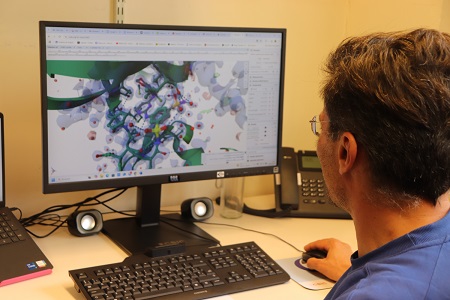
Drugs work in the body by binding to specific targets to prevent, relieve, or treat diseases, modulating specific biological processes. However, they are not always as effective as desired, which remains an ongoing challenge for research. One of the current and relatively unexplored challenges is gaining a deep understanding of the different shapes that drugs can adopt when binding to their target in the body. Better understanding these various forms can help in designing more effective and specific drugs. This could, for example, help reduce adverse side effects.
In recent years, this strategy has been key to guiding the development of new drug candidates against cancer and antibiotics. However, to fully harness its potential, it is essential to have methods that can quickly provide information on the heterogeneity of shapes or conformations, ideally without the need for extensive experiments, measurements, and analyses.
A study led by researcher Francesco Colizzi from the Institute for Advanced Chemistry of Catalonia (IQAC), belonging of the Spanish National Research Council (CSIC), is developing a new approach based on virtual simulations to track all the possible shapes that drugs can adopt when binding to their target receptor.
The study, published in The Journal of Physical Chemistry Letters, provides new insights in basic science to accelerate the design of more effective drugs.
Exploring the Hidden World of Medicines
Drugs (ligands), once inside the body, bind to their target (receptors), thereby activating or blocking a particular cellular function. However, they don’t always adopt the same shape when binding to receptors; instead, they can shift and take on several different conformations—some more common, others less so. This variation influences a drug’s selectivity and effectiveness.
Currently, there’s growing interest in understanding how receptors change shape when interacting with a drugs, but the alternative conformations drugs may adopt after binding are still often overlooked—perhaps because they are difficult to detect.
What’s particularly interesting is that studying the different shapes a potential drug takes when binding to its receptor can provide insights into the strength of certain “anchoring points” between the ligand and its target.
This is the approach researchers at IQAC have taken in their study to better understand how plitidepsin (a marine-derived compound commercialized by PharmaMar) binds to its target and which interactions are critical. A few years ago, plitidepsin entered clinical trials for COVID-19, and these findings may inspire improvements in other existing drugs. In plitidepsin’s case, “its mechanism wasn’t well understood, but we knew that certain structural modifications drastically reduced its activity,” explains Francesco Colizzi.
“That’s why we cannot disregard these alternative forms, even if they are rare—they may hold the key to improving drugs by offering ideas for small chemical tweaks that could make them more effective or selective,” says Francesco Colizzi, researcher at IQAC-CSIC and author of the study.
The most common conformations can be studied using routine experimental lab techniques, but the less frequent ones often escape detection with those same methods. It’s estimated that for even well-studied targets, up to 30% of available 3D structures lack information on possible drug conformations when bound to receptors.
Additionally, experimental techniques are often costly and time-consuming, and current computational models struggle to capture the complexity of larger molecules, such as natural products.
Advanced techniques to visualize molecular motion
In this work, a computational approach based on molecular simulations with extended exploration has been developed, allowing for the visualization and quantification of these hidden forms that are more difficult to detect with experimental methods or the computational methods applied so far. “Sometimes, when we look at a 3D structure of a ligand-receptor complex, we tend to forget that these complexes are just a snapshot of how they interact, and their dynamics can go beyond what could be detected with standard molecular dynamics methods. This is why the use of advanced molecular motion exploration techniques has been key to studying them,” explains Colizzi.
Reconstructing all these conformations could help design more potent drugs by combining the most effective features of different molecular forms. Furthermore, this new approach provides key information on how drugs interact with their receptors, improving the accuracy in the design of new drugs.
“This study began years ago by exploring the movements and different shapes of plitidepsin, a marine compound that was undergoing clinical trials for COVID-19 at that time. Later, I realized that the same method could be applied, in general, to study alternative shapes of drugs in various systems,” concludes Colizzi.
Colizzi, F. Leveraging Cryptic Ligand Envelopes through Enhaced Molecular Simulations. The Journal of Physical Chemistry Letters. DOI: 10.1021/acs.jpclett.4c03215

La mejor actitud que podemos adoptar es la de trat...

The research team observed changes in head circumf...

AtCDF3 gene induced greater production of sugars a...

En nuestro post hablamos sobre este interesante tipo de célula del...

New study finds an association between higher temperatures early in li...