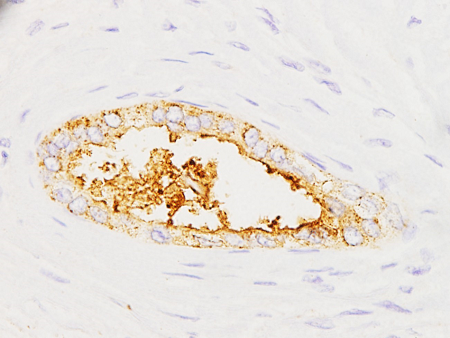
A team from the Institute for Advanced Chemistry of Catalonia (IQAC-CSIC), the Institute of Biomedical Research of Barcelona (IIBB-CSIC) and the Hospital del Mar Research Institute (HMRIB) has developed a test capable of detecting pancreatic cancer within minutes through the analysis of a blood sample on a test strip. The proof of concept for the prototype was carried out using samples from 20 patients and 20 healthy individuals at Hospital del Mar. This is the first trial of a diagnostic test that identifies, in blood plasma, a protein (AXL) that acts as a biomarker for pancreatic ductal adenocarcinoma, the most common and deadliest form of pancreatic cancer. The results reveal a simple, portable and cost-effective method that will need to be further optimised before clinical implementation.
The device uses technology similar to that employed in rapid tests, based on test strips capable of analysing a blood plasma sample in just a few minutes. By optimising various components to improve sensitivity, reproducibility and signal clarity, the test was able to accurately distinguish between pancreatic cancer patients and healthy individuals. These findings, published in the journal Talanta, were obtained after analysing samples from 20 patients and 20 healthy participants at Hospital del Mar in Barcelona.
“This is the first application of a quantitative lateral flow immunoassay — a diagnostic technique that measures the concentration of a substance in a liquid sample — for the detection of sAXL in plasma,” explains Juan Pablo Salvador, researcher at IQAC-CSIC and author of the study.
The assay demonstrates the new method’s ability to identify the presence of the AXL protein in the bloodstream, a biomarker of pancreatic ductal adenocarcinoma. This protein is located on the surface of cells and forms part of the body’s normal functioning, but it is overexpressed in certain types of cancer. In pancreatic cancer, it appears at abnormally high levels in more than 70% of tumours. “Several years ago, we demonstrated that the presence of this soluble protein in the blood (sAXL) is a marker of patients who have already developed the tumour,” explains Pilar Navarro, researcher at IIBB-CSIC and coordinator of the HMRIB Research Group on Novel Molecular Targets in Cancer.
The research team validated the measurements against standard techniques such as ELISA, a reference diagnostic method used in specialised laboratories and hospitals to quantify the presence of antibodies. “This comparison allowed us to confirm the diagnostic relevance of the method,” adds Navarro.
The study represents a promising advance for patients with pancreatic ductal adenocarcinoma, which is the third leading cause of cancer-related death in developed countries. This is partly because the tumour is difficult to detect in its early stages, meaning that more than 85% of diagnoses occur when surgery is no longer an option. “The availability of rapid, accessible and minimally invasive tools to improve early detection represents an urgent clinical need,” the researchers emphasise.
Advantages over conventional diagnostics methods
The technology offers significant advantages over conventional diagnostic approaches: it requires minimal equipment, reduces analysis times and could be readily adapted for use in resource-limited clinical settings or decentralised point-of-care testing, making diagnosis more accessible.
In this regard, Pilar Navarro notes that “our goal is to develop simple and accessible diagnostic tools that can bring pancreatic cancer detection closer to routine clinical practice and help improve patient survival through earlier diagnosis”. Núria Vázquez-Bellón, first author of the study, adds that “this is a promising first step, although the system will still require further optimisation before any potential clinical application”.
An interdisciplinary collaboration
The study is the result of a collaboration supported by the BBQ-CSIC 2022 seed funding programme and, in the words of Pablo García de Frutos, coordinator of the Haemostasis and Immunity Group at IIBB: “This work exemplifies the value of CSIC seed grants in promoting interdisciplinary research with translational potential.” The project also received funding from the Carlos III Health Institute and the Ministry of Science, Innovation and Universities. In addition, it was supported by the pancreatic cancer patient association Acanpan, which contributed to the project’s funding and helped ensure its focus remained aligned with patients’ real needs.
The participating researchers are also affiliated with the Biomedical Research Networking Centres (CIBER) for Bioengineering, Biomaterials and Nanomedicine (CIBER-BBN), Cardiovascular Diseases (CIBER-CV), and Hepatic and Digestive Diseases (CIBER-EHD), as well as the August Pi i Sunyer Biomedical Research Institute (IDIBAPS). Clinical researchers from HMRIB specialising in pancreatic cancer and digestive diseases also took part in this collaborative project.
“Future studies will focus on increasing the number of patients analysed and further improving the system’s sensitivity in order to advance towards possible clinical implementation,” the researchers conclude.
Núria Vázquez-Bellón, Montserrat Rodríguez-Núñez, Neus Martínez-Bosch, Luis E. Barranco, Laura Visa, Pablo García de Frutos, M. Pilar Marco, Pilar Navarro, J. Pablo Salvador. Lateral flow immunoassay detection of soluble AXL for pancreatic ductal adenocarcinoma diagnosis. Talanta. DOI: 10.1016/j.talanta.2026.129973
Image: Expression of the sAXL protein in pancreatic tumours. / IIBB-CSIC

La mejor actitud que podemos adoptar es la de trat...

The research team observed changes in head circumf...

AtCDF3 gene induced greater production of sugars a...

En nuestro post hablamos sobre este interesante tipo de célula del...

New study finds an association between higher temperatures early in li...