The Oceanzyme project was launched at the end of January 2026 and will be carried out thanks to the collaboration of the Biodiversity Foundation of the Ministry for Ecological Transition and the Demographic Challenge, through the Pleamar Programme, and is co-financed by the European Union through the EMFAF (European Maritime, Fisheries and Aquaculture Fund).
Oceanzyme seeks to apply an integrative approach combining metagenomic analysis, enzymatic characterisation and molecular simulations, together with the isolation of bacteria with degradative functional capacity, valorising marine litter collected by fishermen through enzymatic recycling and exploring the application of the resulting products in sectors such as fisheries and aquaculture.
Through passive fishing campaigns, marine litter will be removed from two of Spain’s five marine demarcations — the North Atlantic and the Levantine-Balearic areas. Plastic waste will be characterised in order to analyse its associated microbial communities through metagenomics, while pure culture isolations of bacteria with the potential to degrade different plastic compounds will also be carried out. Enzymes with degradative potential will be identified, modelled in 3D together with the plastic, produced and tested in order to validate their potential use in enzymatic recycling applications.
Marine waste located on deep seabeds, whose average densities in the two marine demarcations mentioned range from 40 to 300 objects/km², is often found in a highly degraded state, having lost its original physico-mechanical properties. In these cases, the mechanical recycling processes usually applied in the treatment of plastic waste are unable to provide a solution capable of producing a material that can be reintroduced into the plastic value chain.
The project combines the expertise of each participating entity in waste removal protocols, marine microorganism studies, molecular simulations and plastic recycling.
Oceanzyme promotes the circular economy, the protection of the marine environment, and technology transfer through a strong communication and dissemination strategy.
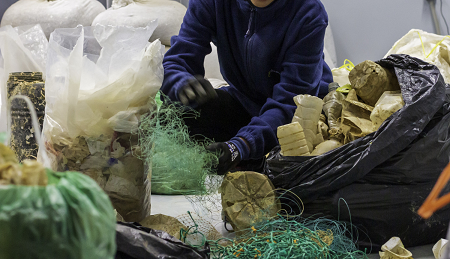
Image: Treatment of marine litter at the facilities of AIMPLAS. Charo Pascual.

La mejor actitud que podemos adoptar es la de trat...

The research team observed changes in head circumf...

AtCDF3 gene induced greater production of sugars a...

En nuestro post hablamos sobre este interesante tipo de célula del...
New study finds an association between higher temperatures early in li...