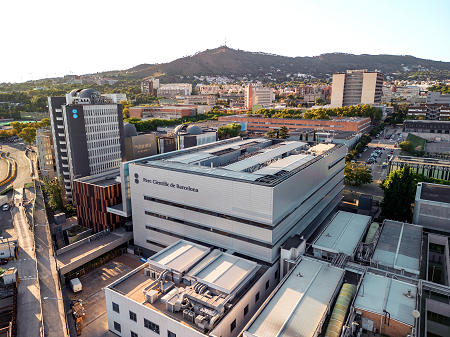
The companies at the University of Barcelona Parc Científic de Barcelona (PCB-UB) set a new investment record in 2025, with a total of €230 million raised by start-ups, spin-offs and scale-ups in the ecosystem. The figure far exceeds the previous record of €142 million, set in 2022. These figures further reinforce the position of the life sciences and health sector as a driver of innovation and economic growth in Catalonia.
The business ecosystem promoted by the University of Barcelona (UB) attracted €202.6 million in private investment in 2025, doubling the previous year’s figure (€97 million), with a 107% increase. In addition, public funds amounted to €27.1 million. Overall, the total investment volume represents an 84% increase over 2024, which closed at €124 million.
The funding raised by the entrepreneurial community at the PCB-UB accounts for 44% of the total investment in the life sciences and health sector in Catalonia. This is shown in the 2025 Catalonia BioRegion Report, prepared by Biocat, which puts the sector’s total investment at €517 million and highlights that life sciences and health already account for 7.6% of Catalonia’s GDP.
The new record high in investment reached by PCB-UB companies is a clear demonstration of the maturity and competitiveness of our innovation ecosystem. According to Maria Terrades, director of the PCB-UB, “the fact that almost half of the capital raised by the life sciences and health sector in Catalonia comes from companies associated with the PCB-UB demonstrates the strength of our environment and its strategic role within the sector, both in Catalonia and in Europe.”
For his part, the rector of the UB, Joan Guàrdia, highlighted that the impact of these figures goes far beyond economic results: “the University of Barcelona Science Park is the essential lever to facilitate the technological transfer that the Catalan research system needs. It is a unique model of collaboration between a public university and the business world, of attracting talent, transfer and research in the field of health sciences. When the future Health Campus Clínic – UB is in operation, the PCB-UB will be part of a research, knowledge and healthcare hub that is unparalleled throughout Europe”.
The biotechnology sector is still the main driver for attracting investment in the life sciences and accounts for most of the capital (€219 million), with a leading role for companies developing new drugs, advanced therapies, diagnostic tools and biomedical technologies, especially in areas such as oncology, the central nervous system and immunology.
SpliceBio, a record investment round in Spain
In a year marked by a record investment in the PCB-UB private sector ecosystem, SpliceBio reached a milestone with the largest funding round ever recorded in Spain’s biotechnology sector. The company, dedicated to the development of innovative gene therapies based on the protein splicing, completed a Series B round of €118 million, enabling it to continue advancing its drug candidate for Stargardt disease, an inherited retinal disorder that causes progressive vision loss leading to blindness, for which no approved treatment currently exists.
Among the most notable operations of 2025 is that of Deepull, a company specialising in the development of rapid molecular diagnostic solutions for severe infections. It closed a Series C round of €50 million, the second-largest transaction ever in the sector in Catalonia, with only SpliceBio ahead of it. This funding will drive the clinical development and commercialisation of UllCORE, an innovative platform for the early diagnosis of sepsis, a condition that has a significant clinical impact and one of the leading causes of hospital mortality worldwide.
The spin-off Orikine Bio, recently established at the PCB-UB, also closed an extension of its seed round worth €5.7 million in 2025. The company is driving a new generation of therapies for autoimmune, inflammatory and oncological diseases through its proprietary Foldkines™ platform.
INBRAIN Neuroelectronics, which last year led private investment in the PCB-UB, continues to grow and raised €3 million in 2025 by expanding a Series B funding round. The deeptech company, which already has more than 50 employees, has developed a graphene-based brain-computer interface, a pioneering technology that enables direct interaction with neuronal activity, offering potential applications in the treatment of neurological disorders and restoring motor functions.
The biotech company Zymvol Biomodeling, which works in computational modelling for the discovery and design of enzymes with applications in the pharmaceutical and chemical industries, closed 2025 having raised a total of €3 million in private investment.
In 2025, biotech companies surpassed €1 million in private investment, among them ALLOX Bio (€2.8 million), MiMark (€1.4 million) and Accure Therapeutics (€1 million). Below these are Lumiris Spectral Solutions (€825,000), OneChain Immunotherapeutics (€810,000), Gate2Brain (€625,000), Aptadel Therapeutics (€620,000), IDP Pharma (€500,000), and Telara Pharma (€400,000); GAT Biosciences (€360,000) also managed to attract private capital last year.
Public investment continues to provide financial stability
Public investment as a source of funding for PCB-UB companies remained solid in 2025, totalling €27.1 million, consolidating a stable base of institutional support within the ecosystem. These funds focus primarily on the therapeutic, diagnostic and medical technology fields through access to competitive calls and innovation support programmes. They include Spanish State and Catalan instruments, such as the PERTE Chip framework, NEOTEC, Torres Quevedo, the State Research Agency’s (AEI) public-private partnership (PPC) projects, other CDTI instruments and ACCIÓ programmes, as well as European programmes such as the EIC Fund and Eurostars.
Companies receiving the most public funding in 2025 include INBRAIN Neuroelectronics, with €4 million, followed by IDP Pharma (€2.5 million), Nuage Therapeutics (€2.25 million), OneChain Immunotherapeutics (€2.18 million), Orikine Bio (€1.89 million), Nanobots Therapeutics (€1.82 million), Lumiris Spectral Solutions (€1.78 million), ENDOR Technologies (€1.62 million), GAT Therapeutics (€1.5 million) and Connecta Therapeutics (€1.13 million). Overall, these companies demonstrate the PCB-UB’s ability to attract public funding for high-value scientific and technological initiatives, particularly in areas such as oncology, the central nervous system, fertility and other lines of biomedical innovation.
Other companies accessing public funding include MiMark (€500,000), Accure Therapeutics (€480,000), ALLOX Bio (€475,000), BeCytes Biotechnologies (€400,000), OloBion (€400,000), Zymvol Biomodeling (€340,000), Aptadel Therapeutics (€324,000), Telara Pharma (€150,000), Gate2Brain (€99,000), Chemotargets (€77,500) and Pharmacelera (€70,000).
New buildings to consolidate the growth of the PCB-UB
The sector’s growth and strong demand for space will be bolstered by the construction of two new buildings dedicated to research and innovation, where further progress was made throughout 2025. The CUB building is developing as planned: the jury for the design competition selected the proposal by Elastiko Architects, and in October the preliminary design was presented, enabling the planning application to begin. The new building will add an additional 2,700 square metres to the ecosystem for research and innovation activities. During 2026, the administrative and technical phases of the project will be completed with the tendering of the works, for construction to begin in 2027. Users are expected to enter in January 2028.
At the same time, the UB is promoting the MIES-UB project (mathematics, computer science, economics and health), which foresees the construction of two buildings on the Diagonal Campus, with a combined area of 24,000 square metres. One, adjacent to Avinguda Diagonal, will house the new headquarters of the Faculty of Mathematics and Computer Science. The other building, with 10,000 square metres above ground and designed as a strategic node for health and bioengineering research, will serve to expand the PCB-UB. The facility will house the Institute for Bioengineering of Catalonia (IBEC), the Fraunhofer Institute and various UB research groups, in a space designed to combine wetlabs and drylabs with shared working and scientific interaction zones. In September 2025, the jury selected the winning architectural proposal, and the facility, managed by PCB-UB, is scheduled to come into operation in 2029.
This expansion process is part of the strategic Campus Clínic–UB project, aimed at creating a major centre for research, knowledge transfer and healthcare in Barcelona. The process will culminate in the relocation of the future Hospital Clínic de Barcelona on the grounds of the UB Sports facilities next to Avinguda Diagonal.
▪ About the University of Barcelona Science Park (PCB-UB):
The Parc Científic de Barcelona of the University of Barcelona (PCB-UB) is one of Europe’s leading ecosystems for scientific, technological and business innovation in life sciences and health. Established by the University of Barcelona in 1997, it was the first science park in Spain. Covering an area of 100,000 m², the PCB-UB is home to a highly dynamic community, comprising 111 public and private bodies and more than 3,600 researchers, entrepreneurs and professionals (57% of whom are women), whose work is mainly in emerging areas in life sciences (biomedicine, biotechnology, medical devices, eHealth, cosmetics and nutrition). A distinctive feature of the PCB-UB is its wide range of scientific and technological services to facilitate RDI, offered to both resident organisations and external national and international companies and research groups. These services are complemented by a programme to stimulate the PCB-UB community, which seeks to develop interaction among its members and with the innovation ecosystem. Among its strategic lines, PCB-UB organises science outreach activities to bring research closer to the public, foster dialogue between the public and researchers, and encourage scientific careers among young people. It currently organises more than 100 annual activities as part of its RESSÒ (Recerca en Societat) programme, in which 7,500 people participate. More information: www.pcb.ub.edu

La mejor actitud que podemos adoptar es la de trat...

The research team observed changes in head circumf...
AtCDF3 gene induced greater production of sugars a...
En nuestro post hablamos sobre este interesante tipo de célula del...

New study finds an association between higher temperatures early in li...