A recent comparative study published in Journal of Chromatography A evaluates two prevalent techniques for preparative oligonucleotide purification: Ion Exchange Chromatography (IEX) and Ion-Pair Reversed-Phase Liquid Chromatography (IP-RPLC).
Using a crude 20-mer DNA oligonucleotide, the study investigated key parameters such as gradient slope and column load under realistic laboratory conditions.
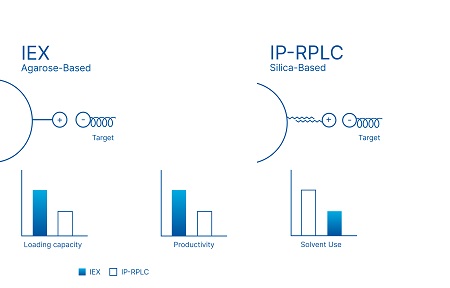
The results highlight that agarose-based IEX resins offer superior productivity and solvent efficiency compared to silica-based IP-RPLC media (Figure 1).
Despite longer cycle times, IEX achieved significantly higher loadability—translating into 2 to 7 times greater productivity depending on the target purity (95–99%)—while consuming only one-third to one-tenth the amount of solvent.
The anti-Langmuirian elution profile observed in IEX further contributed to better separation efficiency and reduced loss of the full-length product at high purities.
It is concluded that IEX is the preferred technique for large-scale oligonucleotide purification, especially when high throughput and environmental considerations are prioritized. Additionally, IEX operates at ambient temperature and does not require toxic organic solvents or ion-pairing reagents.
These findings support the use of agarose-based IEX resins, such as those offered by ABT (Agarose Bead Technologies). ABT’s Q Rapid Run™ (High Sub) Agarose Beads are strong anion exchange resins that are ideal for oligonucleotide purification workflows.
The beads offer high dynamic binding capacities, gentle processing conditions, and scalable performance from the laboratory to production scale.
Figure: A comparison of agarose-based Ion Exchange Chromatography (IEX) and silica-based Ion-Pair Reversed-Phase Liquid Chromatography (IP-RPLC) for oligonucleotide purification, highlighting loading capacity, productivity, and solvent use
GET TO KNOW MORE ABOUT OUR IEX RESINS FOR OLIGONUCLEOTIDE PURIFICATION

La mejor actitud que podemos adoptar es la de trat...

El equipo de investigadores observó cambios en el...
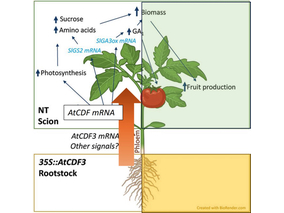
El gen AtCDF3 promueve una mayor producción de az...
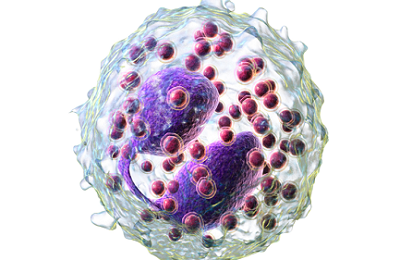
En nuestro post hablamos sobre este interesante tipo de célula del si...

Curapath se complace en reconocer el importante avance logrado por Mac...