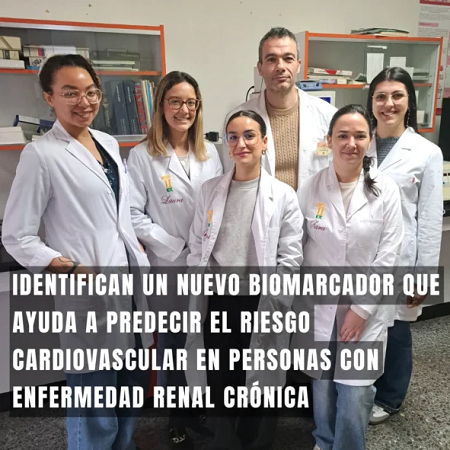
The Clinical Pharmacogenetics research group at the University of Extremadura (FARCLIN), coordinated by Professor of Pharmacology Guillermo Gervasini , has developed an innovative model capable of predicting cardiovascular risk in people with Chronic Kidney Disease (CKD), a condition that affects kidney filtration and accelerates the body's aging process. The results of their research were recently published in the Journal of Clinical Medicine , where they were also featured on the cover. This article is the latest in a series of publications on biomarkers in kidney patients, a topic studied by UEx researchers over the past 10 years, resulting in 14 international articles.
In the management of chronic kidney disease, the goal is to improve the quality of life of those affected. In this regard, the aim is both to avoid dialysis and transplantation and to anticipate cardiovascular events, because this disease causes premature aging, which manifests as a high risk of cardiovascular events. “However, we don't have markers that we can see in a blood test or a genetic analysis that would tell the nephrologist whether a patient will have a higher or lower risk of suffering a cardiovascular event, because the classic risk factors—weight, age, diabetes, and hypertension—don't fully explain this high cardiovascular risk,” notes Guillermo Gervasini.
In this context, research by the University of Extremadura (UEx) and the University Hospital of Badajoz has emerged, with the aim of identifying biomarkers that can predict which patients may be at higher risk of suffering a heart attack, stroke, or other cardiovascular events. “The nature of the study falls within the framework of personalized medicine, that is, treatment that focuses on the person and not the disease. Genetic analysis and other factors such as age, environment, and lifestyle influence the patient's therapeutic response,” Gervasini emphasizes.
Thus, in 2016 a clinical study was initiated at the University Hospital of Badajoz, which has so far involved nearly 900 patients with Chronic Kidney Disease. In this follow-up, the research team has measured fibroblast growth factors and, specifically, has analyzed together for the first time the levels of the protein FGF19, a factor that has been little studied until now, and β-Klotho, a hormone involved in anti-aging.
In addition, advanced biostatistical models have been applied to this data, integrating biomarkers, genetics and classic risk factors (diabetes, hypertension, obesity, smoking…) collected in clinical practice during the years of follow-up of patients.
The resulting model generates an individual score that is easy to use clinically. Patients with low FGF19 and high Klotho levels experienced more cardiovascular events during follow-up. The study therefore proposes this new combined FGF19–Klotho biomarker, validated in a large cohort in Badajoz, although, as the professor from the University of Extremadura points out, multicenter studies with other hospitals are needed to confirm the finding in different populations before it can be applied in clinical practice.
Chronic Kidney Disease affects millions of people and has no cure. “Treatments are aimed at slowing the progression of the disease. Doctors try to control the factors that trigger it, such as diabetes, high blood sugar, and high blood pressure. Therefore, it is necessary to have tools that allow for personalized medicine and intervention before cardiovascular damage occurs, thus improving patients' quality of life,” concludes the UEx researcher.
Bibliographic reference: González-Rodríguez L, Martí-Antonio M, Díaz-Acevedo V, Mota-Zamorano S, Chicharro C, Cancho B, Gil-Lozano R, Verde Z, Bandrés F, Robles NR, et al. Interplay Between Fibroblast Growth Factor-19, Beta-Klotho, and Receptors Impacts Cardiovascular Risk in Chronic Kidney Disease. Journal of Clinical Medicine . 2026; 15(3):1005. https://doi.org/10.3390/jcm15031005

La mejor actitud que podemos adoptar es la de trat...

The research team observed changes in head circumf...

AtCDF3 gene induced greater production of sugars a...

En nuestro post hablamos sobre este interesante tipo de célula del...

A paper published in Alzheimer’s & Dementia: The Journal of the Alzh...