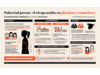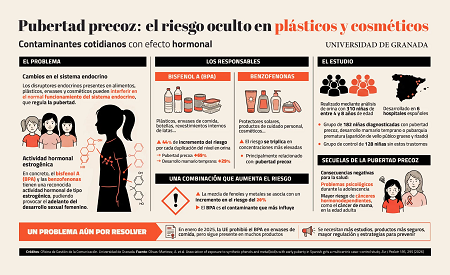
A study by the University of Granada and the Granada Institute for Biomedical Research, ibs.GRANADA, recently published in European Journal of Pediatrics A study has revealed that girls with higher levels of bisphenol A (a component of plastics and epoxy-phenolic resins) and benzophenones (ultraviolet filters) in their urine are more likely to experience precocious puberty or early breast development. The study, conducted with 310 girls from six Spanish hospitals, shows that the risk increases by 44% for every doubling of BPA levels and triples in the case of benzophenones.
A team led by the group's principal investigator Ee19-Toxicology Carmen Freire, from ibs.GRANADA and professor in the Department of Legal Medicine, Toxicology, and Physical Anthropology at the University of Granada, analyzed urine samples from 182 girls between the ages of 4 and 8 diagnosed with precocious puberty, premature thelarche (early breast development), or other variants such as early pubarche. An additional 128 girls without these disorders also participated, serving as a control group. The study involved pediatricians from the pediatric endocrinology departments of six Spanish hospitals, including the [hospital name missing in original text]. San Cecilio Clinical Hospital of GranadaIt has been funded by the Carlos III Health Institute.
Everyday pollutants with hormonal effects
Endocrine disruptors are chemical substances found in the environment, in food, and in everyday consumer products such as plastics, food packaging, cosmetics, and personal care products. These substances can interfere with the normal functioning of the endocrine system, which regulates puberty. Specifically, BPA and benzophenones have recognized estrogenic-like hormonal activity, which could accelerate female sexual development.
The study quantified phenolic compounds (bisphenols, parabens, and benzophenones) and several metals in urine. The results show that, individually, BPA is associated with a 44% increased risk of any signs of early puberty for every twofold increase in its levels in urine. For precocious puberty, the risk increases by 69%, and for premature thelarche, by 29%. In the case of benzophenones, higher concentrations were linked to approximately three times the risk of precocious puberty. When phenols and metals were analyzed together, the risk increased by 20%, with BPA being the contaminant that contributed most to this effect.
Precocious puberty not only disrupts the rhythm of childhood development, but it also has negative health consequences later in life, such as psychological problems during adolescence and an increased risk of hormone-dependent cancers, like breast cancer, in adulthood. Several studies have demonstrated a widespread trend toward earlier puberty in recent years, especially in girls, and cases of precocious puberty in its various forms are becoming increasingly common in pediatric clinics.
Although scientific evidence on the impact of these endocrine disruptors remains limited for many of them, this study provides new data by analyzing several substances in combination. The authors emphasize that, despite the European Union's ban on the use of BPA in food contact materials such as cans and plastics in January 2025, sources of exposure are highly diverse, and there is no certainty that current levels are still safe for children.
Need for more studies and preventative measures
Given the widespread exposure to these chemicals, the study's authors emphasize the need for continued high-quality evidence on the effects of mixtures of endocrine disruptors and other environmental toxins on precocious puberty. They also highlight the importance of implementing preventative strategies to reduce exposure in vulnerable populations, such as educational interventions, stricter regulations, the development of products with safer formulations, and more efficient environmental management.
Bibliographic reference (full text of the study)
Olivas-Martinez, A., Escribano, A., Riaño-Galán, I. et al. Association of exposure to synthetic phenols and metal(loid)s with early puberty in Spanish girls: a multicentric case–control study. Eur J Pediatr 185, 295 (2026). https://doi.org/10.1007/s00431-026-06919-1
Image: The research results link the presence in urine of higher levels of bisphenol A (a component of plastics and epoxy-phenolic resins) and benzophenones (ultraviolet filters) with a greater likelihood of girls experiencing precocious puberty or early breast development.

La mejor actitud que podemos adoptar es la de trat...
The research team observed changes in head circumf...
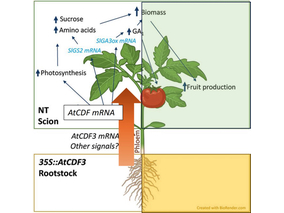
AtCDF3 gene induced greater production of sugars a...
En nuestro post hablamos sobre este interesante tipo de célula del...

Acute myeloid leukemia (AML) does more than infiltrate the lungs: it a...