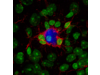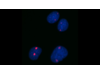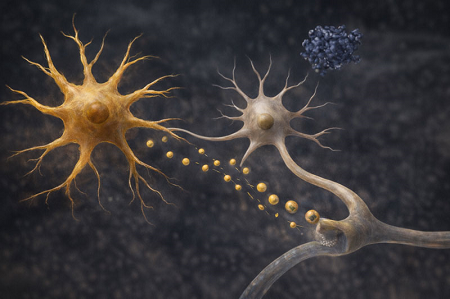
A research team has identified a previously unknown mechanism through which astrocytes, a type of glial cell in the brain, can modulate the function and health of neurons in the context of Alzheimer’s disease. The work, recently published in the scientific journal Journal of Extracellular Vesicles, is led by Jimena Baleriola, head of the Laboratory of Local Translation in Neurons and Glia at Achucarro, with the close participation of Juan Manuel Falcón, CIBERehd, Ikerbasque Research Professor and leader of the Exosomes Group at CIC bioGUNE, member of BRTA.
The team found that when astrocytes are exposed over time to beta-amyloid (Aβ) oligomers, one of the main proteins involved in Alzheimer’s, they respond by releasing extracellular vesicles (EVs) that are especially rich in ribosomal proteins, including Rps6, a key component of the protein production machinery.
Extracellular vesicles are tiny particles released by cells that act as messengers, transporting proteins, lipids, and genetic material between cells. In this study, the researchers observed that EVs produced by astrocytes exposed to Aβ were preferentially taken up by neuronal axons.
Once inside neurons, these vesicles stimulate local protein synthesis, a process essential for maintaining synapses and supporting neuronal plasticity. The presence of ribosomal proteins such as Rps6 enhances protein production in axons, even under the stressful conditions associated with Alzheimer’s disease.
Importantly, this astrocyte–neuron communication had a direct impact on synaptic health. Neurons that absorbed astrocyte-derived EVs showed higher levels of synaptic markers, suggesting a protective effect against beta-amyloid–induced damage.
“The results were completely unexpected, as astroglial EVs that carry Aβ resistant to degradation are known to be neurotoxic, we observed the opposite effect”, highlights Jimena Baleriola. “Additionally, EVs released by astrocytes exposed to Aβ oligomers do not seem to contain more Aβ than control EVs. This opens the possibility that astrocytes respond to subchronic amyloid pathology by attempting to protect neurons by releasing EVs. It would be interesting to address if prolonged treatment of astroglia with Aβ would switch their EVs from being protective to being detrimental. This could help identify a time window in with astroglial EVs can be exploited for their neuroprotective roles in AD”.
“This project has posed a significant challenge from the perspective of extracellular vesicle biology. Given the extremely limited amount of material secreted by primary astrocytes and neurons, we have devoted substantial effort to optimizing, as far as possible, the methods for isolating and characterizing extracellular vesicles from very small volumes of conditioned media”, explains Juan Manuel Falcón.
Overall, the discovery offers fresh insight into the role of glial cells in neurodegenerative disorders and points toward new therapeutic approaches based on regulating extracellular vesicles and local protein synthesis in neurons.
By identifying a potential astrocyte-driven neuroprotective mechanism, the study reinforces the idea of the brain as a complex network of interacting cells, where communication between different cell types can determine whether neurons degenerate or remain resilient.
Reference: María Gamarra, Aida de la Cruz-Gambra, Maite Blanco-Urrejola, Esperanza González, Mikel Azkargorta, Felix Elortza, Juan Manuel Falcón-Pérez, Jimena Baleriola. Vesicular Rps6 Released by Astrocytes in an Experimental Model of AD Regulates Local Translation and Enhances Synaptic Integrity in Neurones. J Extracell Vesicles. DOI: 10.1002/jev2.70216.
Photograph by: © Figure created by AI.
About Achucarro
Achucarro Basque Center for Neuroscience was created by the joint efforts of the University of the Basque Country (UPV/EHU) and Ikerbasque. It is the only center in Spain fully committed to the understanding of glia-neuron communication in the healthy and the diseased brain.
About CIC bioGUNE
The Centre for Cooperative Research in Biosciences (CIC bioGUNE), member of the Basque Research & Technology Alliance (BRTA), located in the Bizkaia Technology Park, is a biomedical research organisation conducting cutting-edge research at the interface between structural, molecular and cell biology, with a particular focus on generating knowledge on the molecular bases of disease, for use in the development of new diagnostic methods and advanced therapies.
About Ikerbasque
Ikerbasque -Basque Foundation for Science- is the result of an initiative of the Department of Education of the Basque Government that aims to reinforce the commitment to scientific research by attracting, recovering and consolidating excellent researchers from all over the world. Currently, it is a consolidated organization that has 290 researchers/s, who develop their work in all fields of knowledge.
About BRTA
BRTA is an alliance of 4 collaborative research centres (CIC bioGUNE, CIC nanoGUNE, CIC biomaGUNE y CIC energiGUNE) and 13 technology centres (Azterlan, Azti, Ceit, Cidetec, Gaiker, Ideko, Ikerlan, Leartiker, Lortek, Neiker, Tecnalia, Tekniker y Vicomtech) with the main objective of developing advanced technological solutions for the Basque corporate fabric.
With the support of the Basque Government, the SPRI Group and the Provincial Councils of the three territories, the alliance seeks to promote collaboration between the research centres, strengthen the conditions to generate and transfer knowledge to companies, contributing to their competitiveness and outspreading the Basque scientific-technological capacity abroad.
BRTA has a workforce of 3,500 professionals, executes 22 % of the Basque Country's R&D investment, registers an annual turnover of more than 300 million euros and generates 100 European and international patents per year.

La mejor actitud que podemos adoptar es la de trat...

The research team observed changes in head circumf...
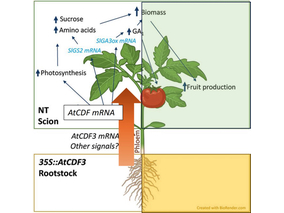
AtCDF3 gene induced greater production of sugars a...
En nuestro post hablamos sobre este interesante tipo de célula del...
Un estudio del Instituto de Neurociencias (CSIC-UMH) muestra en modelo...