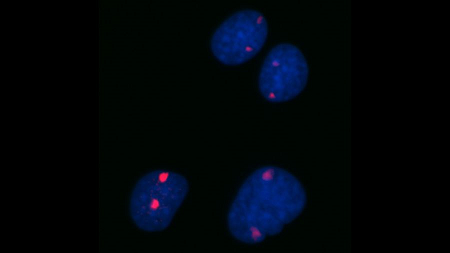
How diseases develop and how the body ages can differ between females and males, but the biological reasons for these differences are not fully understood. Among the most promising lines of research is the role of sex chromosomes to better understand what may be driving these differences.
This recently published international study has taken important steps towards clarifying these differences. The study has identified SIRT7, a protein involved in how cells respond to stress and ageing, and how it plays a critical role in maintaining the health of the X chromosome. The discovery is particularly important for women, who have two X chromosomes, compared with males who have one.
The study was led by Jeannie Lee, researcher at Mass General Brigham, Boston (USA), and Alejandro Vaquero, researcher at the Josep Carreras Leukaemia Research Institute in Barcelona. Published in the journal Nature with Nicolas Simonet as first author, the study also included the involvement of Aurora Ruiz-Herrera, Berta Vázquez, Laia Marín-Gual and Cristina Marín-García, researchers from the Institute of Biotechnology and Biomedicine (IBB-UAB) and the Department of Cellular Biology, Physiology and Immunology at the UAB.
In female cells, one X chromosome is normally “turned off” to keep gene activity balanced. But the researchers found that when SIRT7 is missing, this balance breaks down. The inactive X chromosome becomes overly silenced. More surprisingly, the active X chromosome becomes too active. This overactivity disrupts normal gene regulation and makes the chromosome prone to DNA damage and genome instability.
These effects were strongest in females. In animal models, females lacking SIRT7 showed more DNA damage, poorer health and shorter lifespans compared with males.
“We were able to observe that the loss of the SIRT7 protein compromises the viability of female mice in many developmental stages, including late embryonic development and adult life”, Berta Vázquez and Aurora Ruiz-Herrera point out.
The findings suggest that SIRT7 acts as a genetic safeguard, keeping the active X chromosome stable and its gene activity in check. Without the protein, the delicate balance that cells rely on is lost.
This research provides new insight into why ageing, disease risk and biological responses can differ between sexes. By uncovering how the X chromosome is regulated, the study may help inform future approaches to understanding and treating conditions that affect females and males differently.
Implications for blood cancer research
Alterations in X chromosome activity can influence how blood and immune cells develop and function, potentially contributing to immune dysregulation and to the sex differences observed in susceptibility to certain diseases.
This connection may also be relevant to blood cancers, where the normal development and function of blood and immune cells are disrupted. A previous study from Alejandro Vaquero’s lab, also led by Berta Vazquez, had already shown that SIRT7 helps maintain the activity of PAX5, a gene that plays a key role in blood cell development and is frequently altered in leukaemia.
Alejandro Vaquero, group leader at the Josep Carreras Leukaemia Research Institute, points out that this new study reveals “a new role for SIRT7 in protecting chromosome stability” and therefore “broadens our understanding of how changes in this protein may affect immune system regulation and contribute to blood cancers”.
Original article: Simonet, N.G., Thackray, J.K., Kesner, B. et al. SIRT7 regulates dosage compensation and safeguards the female X chromosome. Nature (2026). https://doi.org/10.1038/s41586-026-10645-x

La mejor actitud que podemos adoptar es la de trat...

The research team observed changes in head circumf...
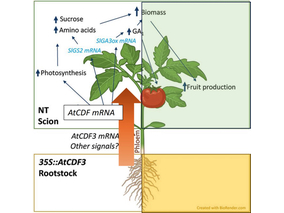
AtCDF3 gene induced greater production of sugars a...
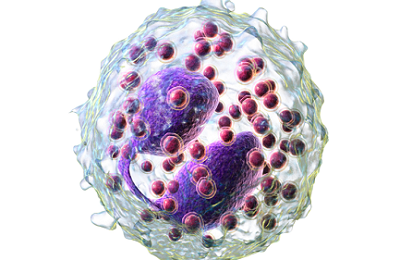
En nuestro post hablamos sobre este interesante tipo de célula del...
The direct analysis of human heart tissue from transplant recipients w...