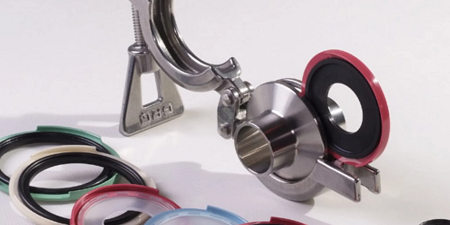
Purchasing process components for a pharmaceutical facility is not like buying any other industrial supply. In a GMP (Good Manufacturing Practices) regulated environment, every component in contact with the product must be qualified, its materials must be documented, and the supplier must be able to provide the traceability necessary for validation processes. This guide explains what to order, what to verify, and how to manage the approval of clamp fittings, pharmaceutical-grade hoses, pharmaceutical-grade silicone tubing, peristaltic tubing, and diaphragm valves.
Why Component Validation Is Critical in GMP
In a GMP facility, the equipment and auxiliary materials are part of the validated process. This means that any change to a component—even a change of clamp gasket supplier—may require an impact assessment and, in some cases, a partial revalidation of the process.
The consequences of using unqualified components can be serious:
• Contamination of the product with extractables or particles of the material
• Regulatory non-compliance detectable in FDA, EMA or AEMPS audits
• Need to withdraw batches from the market
• Rejection of batches in final quality control
Therefore, the qualification process for suppliers and components must be addressed from the beginning of the project, not as a step after installation.
Essential Documentation for Clamp Joints and Pharmaceutical Tubing
When purchasing clamp fittings, pharmaceutical hoses, pharmaceutical silicone tubing, or peristaltic tubing for use in GMP installations, always require the following documentation:
• FDA 21 CFR Certificate of Conformity: indicates that the material complies with American regulations for contact with food and pharmaceutical products.
• USP Class VI Declaration of Conformity: The most demanding level of biocompatibility according to the US Pharmacopeia. Includes cytotoxicity, systemic implantation and intradermal testing.
• Batch Certificate of Analysis (CoA): provides data for the specific batch supplied, including mechanical properties and conformity test results.
• Safety data sheet (SDS/MSDS): information on the composition, hazards and safe handling of the material.
• Extractables and leachables data: especially critical in bioprocessing and the production of injectable products. Identifies which compounds can migrate from the material to the fluid under process conditions.
• Declaration of absence of latex, phthalates and other substances of very high concern (SVHC according to REACH).
• Certificate of conformity with EC 1935/2004 (for food contact applications in Europe).
Qualification of Process Component Suppliers
In GMP, supplier qualification is as important as the qualification of the component itself. A qualified supplier must be able to demonstrate:
• Certified quality management system (ISO 9001 minimum; ISO 13485 for medical device components).
• Traceability of raw materials: the supplier must be able to trace the origin of the base materials back to the polymer manufacturer.
• Documented change control: any changes to the production process, raw materials, or specifications must be notified to customers with sufficient time to assess the impact.
• Auditability: the supplier must be willing to be audited by the client or by regulatory bodies.
• Quality track record: references in the pharmaceutical sector, experience with FDA/EMA audits.
For high-criticality facilities (production of injectables, biopharmaceuticals), it is advisable to conduct a formal audit of the supplier before approval.
The Component Qualification Process
The qualification of a process component (clamp joint, diaphragm valve, pharmaceutical hose…) usually follows these steps in GMP environments:
1. User Specification (URS): definition of the component's technical and regulatory requirements.
2. Supplier evaluation: request for technical documentation and evaluation of the quality of supply.
3. Compatibility tests: laboratory tests to verify the compatibility of the material with process fluids and cleaning agents under real-world conditions of use.
4. Installation Qualification (IQ): verification that the component has been installed correctly and according to specifications.
5. Operational Qualification (OQ): verification that the component functions correctly within the specified operating ranges.
6. Process Qualification (PQ): verification that the component, under normal operation, produces results consistent with the process requirements.
7. Formal approval and homologation: inclusion of the component in the list of approved materials of the quality system.
Supplier or Specification Change Management
One of the most critical moments in GMP component management is changing suppliers or specifications. For example, if the usual supplier of clamp gaskets stops manufacturing a particular grade of silicone, or if the peristaltic tubing is replaced with tubing from a different manufacturer.
In these cases, the change control process should include:
• Evaluation of the impact of the change on the validated process
• Technical comparison of the new component with the previous one (same or better specifications)
• Review of the conformity documentation for the new component
• Compatibility testing if the change involves a different material
• Updating the quality system documentation
• Communication to the end customer if the component is part of a registered medicinal product
Rigorous change control management protects both the manufacturer and the end patient.
Conclusion
Properly validating and certifying hygienic process components—clamp fittings, pharmaceutical-grade hoses, silicone tubing, diaphragm valves—is an investment that protects process integrity and regulatory compliance. Don't skimp on documentation or supplier qualifications. If you need assistance gathering qualification documentation for our products or preparing for a supplier audit, our technical department is available to help.

La mejor actitud que podemos adoptar es la de trat...

The research team observed changes in head circumf...

AtCDF3 gene induced greater production of sugars a...

En nuestro post hablamos sobre este interesante tipo de célula del...

The direct analysis of human heart tissue from transplant recipients w...