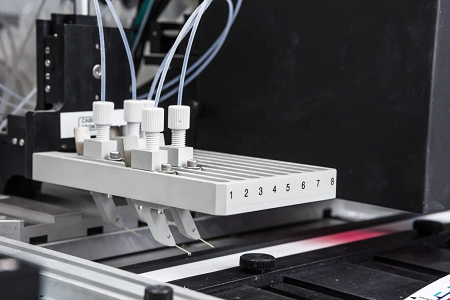
Making the transition from a laboratory-validated test to the industrial manufacture of rapid tests is one of the most critical stages in the life cycle of an in vitro diagnostic (IVD) product. It is not simply a matter of producing more units, but of doing so in a reproducible and efficient manner, whilst complying with regulatory requirements. For this reason, more and more companies—from start-ups to established laboratories—are opting to outsource the manufacture of diagnostic tests as a strategic decision, rather than as a stopgap solution.
For years, outsourcing IVD production was seen as a ‘plan B’, reserved for when resources were lacking or unexpected problems arose. Today, as Pat Vaughan of DCN noted in his article “Why Diagnostics Teams Outsource, and What to Expect When You Do”, that view has changed. Even the most experienced teams are beginning to incorporate IVD contract manufacturing from the early stages of their industrial planning with a clear objective: to reduce technical risks, accelerate time to market and ensure the reproducibility of industrial batches.
Capacity and response time: the real bottleneck
One of the main challenges when scaling up production is limited internal capacity. Many companies and departments possess extensive scientific expertise, but lack the industrial infrastructure, specialist staff or operational flexibility required to manufacture rapid tests on a large scale within tight deadlines.
An in vitro diagnostic CMO (contract manufacturing organisation) relieves internal teams of this burden, avoiding complex recruitment processes or significant investment in facilities and equipment. While the client focuses on the business, marketing or regulatory strategy, the contract manufacturer ensures that the product is manufacturable, scalable and consistent from batch to batch.
Furthermore, working with an experienced industrial partner allows progress to be made in parallel: process development, validations, scale-up and the generation of reproducible and auditable data, all without slowing down the project’s pace.
Not all manufacturers are the same
Outsourcing should not mean ‘manufacturing blindly’. A good IVD contract manufacturing partner does not merely follow instructions, but brings industrial expertise to the table. Their experience gained across multiple programmes enables them to identify common risks associated with scale-up, discrepancies between expected performance and actual production outcomes, or critical points that could lead to costly rework.
This proactive approach is particularly valuable when the product performs well under laboratory conditions but needs to be reliably reproduced in an industrial setting. Identifying these issues before large-scale production saves time, money and avoids regulatory delays.
Lower regulatory risk, greater control
Large-scale manufacturing of IVD tests is closely linked to regulatory compliance. Poorly defined processes, data that is difficult to reproduce, or discrepancies between what is documented and what is manufactured can become significant obstacles during audits or regulatory milestones.
A partner specialising in IVD manufacturing operates with a compliance-focused mindset, generating traceable processes, auditable data and documentation that is aligned with regulatory requirements. Far from losing control, the client gains visibility and predictability.
This also includes the protection of intellectual property (IP). With clear agreements, confidentiality protocols and robust quality systems, outsourcing strengthens project control by reducing uncertainty and rework.
Scale up with confidence
Outsourcing the production of rapid diagnostic tests is not a sign of weakness, but of maturity. It is the most efficient way to transform a validated prototype into a robust, reproducible and market-ready industrial product. With the right partner, manufacturing ceases to be a source of risk and becomes a catalyst for success.
With over 45 years’ experience in the industrial manufacture of rapid in vitro diagnostic tests, OPERON’s contract manufacturing service provides the capacity, control and technical expertise to ensure scalable, reproducible production that is aligned with market and regulatory requirements.

La mejor actitud que podemos adoptar es la de trat...

The research team observed changes in head circumf...

AtCDF3 gene induced greater production of sugars a...
En nuestro post hablamos sobre este interesante tipo de célula del...

New study finds an association between higher temperatures early in li...