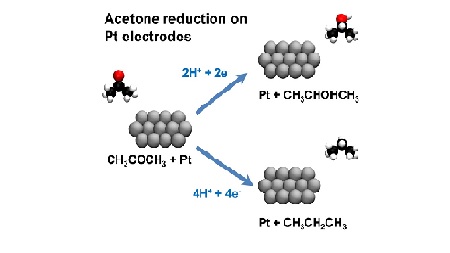
The Paris agreement on climate change and scientific and technological growing interest in the valorisation of biomass are leading researchers to finding new ways of doing traditional organic chemistry. This includes the improvement of transformation of common compounds such as acetone in alcohol and hydrocarbon, and vice-versa.
In a joint study published in the journal Nature Catalysis, researchers from the Institute of Theoretical and Computational Chemistry of the University of Barcelona (IQTC-UB) and the Institute of Chemistry of Leiden University (the Netherlands), studied the electrochemical reduction of acetone, the most simple and probably most important ketone.
Researchers found out that some platinum electrodes used in the electrochemical cell are inert, others produce propane (alkane) and others produce isopropanol (an alcohol). According to the authors, this selection occurs due the atomic scale structure of platinum electrodes. This study offers new alternatives which may be more sustainable to reach traditional organic.
Article reference:
C. J. Bondue, F. Calle-Vallejo, M. C. Figueiredo i M. T. M. Koper. "Structural principles to steer the selectivity of the electrocatalytic reduction of aliphatic ketones on platinum". Nature Catalysis (2019). Doi: 10.1038/s41929-019-0229-3

La mejor actitud que podemos adoptar es la de trat...

The research team observed changes in head circumf...
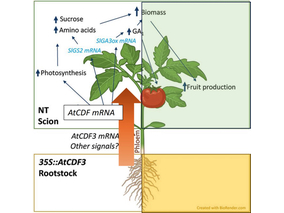
AtCDF3 gene induced greater production of sugars a...
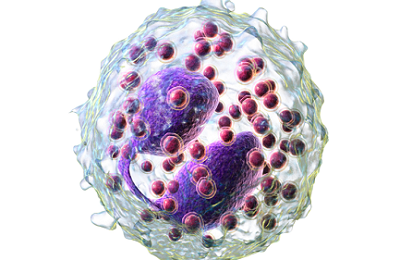
En nuestro post hablamos sobre este interesante tipo de célula del...

New study finds an association between higher temperatures early in li...