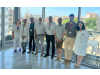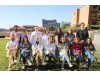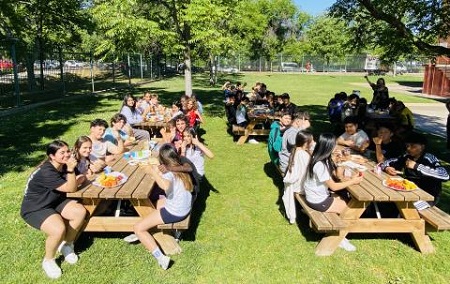
“ Give your health a like: have a leisurely breakfast and move your body.” With that real-life “like,” 40 first-year ESO students from the IES Grande Covián in Zaragoza began their day today with a physical exercise session, body measurements, and a healthy breakfast organized by the school and the GENUD Group (Growth, Exercise, Nutrition, and Development) of the University of Zaragoza , taking advantage of the celebration of World Nutrition Day . A joint initiative to convey a clear message to children, adolescents, and young people: “There is not enough fruit and dairy products in the first meal of the day, and there is too much rushing and ultra-processed food . There is also too much screen time , which promotes a sedentary lifestyle and worsens the physical condition of children.” These are the words of Luis Moreno, coordinator of GENUD, a pioneering team in Spain and Europe in researching the causes of overweight and obesity, diseases that, according to data from the latest Aladino report from the Ministry of Consumption (2023), affect 36.1% of children aged 6 to 9 in Spain.
The choice of this educational center to alert society as a whole to this reality is no coincidence. The physician and researcher Francisco Grande Covián , closely associated with the city of Zaragoza, focused his research on nutrition and biochemistry . "Furthermore," explains the institute's director, Mónica Aguilera Alcolea, "this activity is part of Grande Covián Week, and we believe it is important to keep alive the research purpose to which he dedicated his life: the importance of nutrition for our health. Let's not forget that Grande Covián was also the founder and first president of the Spanish Society of Nutrition ." Indeed, the GENUD Group also took its first steps at this educational center 20 years ago, beginning to train its researchers here.
“Motor Illiteracy”
The day began with recreational physical exercise. “Eighty percent of adolescents do not meet the physical activity recommendations, which are 60 minutes of moderate-to-vigorous movement daily and three days a week of musculoskeletal strengthening,” explains José Antonio Casajús, professor of Physical Activity and Health at the University of Zaragoza . “In practice,” this expert points out, “this translates into what pediatricians are already labeling as the pediatric triad: the combination of insufficient daily activity, a loss of physical fitness, and motor illiteracy, which create a health risk for this population.” We are observing "a loss of between 5 and 10% of aerobic fitness and flexibility ," as revealed by preliminary data from a study the GENUD Group is conducting on a group of 1,500 children and adolescents from Aragon, which they are comparing with the study they conducted between 1995 and 2000. "This loss has significant repercussions on their present and future health," Casajús emphasizes.
After exercising, the 40 boys and girls had to replenish their strength with a good breakfast. “To acquire healthy habits and start the day with the nutrients and energy needed to be more focused and perform well in school, it's vital to have a conscious and balanced breakfast and to incorporate physical exercise into our daily routine,” Moreno emphasized. “A balanced breakfast , which allows boys and girls to perform optimally throughout their day, should include seasonal fruit, cereals, and dairy products,” Moreno emphasized, emphasizing the importance of the latter. “One of the studies conducted with the HELENA group (a European initiative aimed at effectively understanding and improving the nutritional habits and lifestyles of adolescents in Europe, coordinated from Zaragoza) showed that milk and dairy products have a protective effect against excessive fat accumulation, especially in girls,” she emphasized. Those not invited to this table are ultra-processed products, whose negative health consequences FESNAD, the Nutrition Federation, warns about this year in the slogan chosen for this world day: "Processing, safety, sustainability, and health." Along these lines, Moreno emphasized the importance of returning to the Mediterranean diet: more grains, fruits, vegetables, and fish, and fewer sugary drinks and easy-to-eat foods high in calories, fat, and salt.
Time, an essential ingredientFu
rthermore, the members of this world-renowned research group on overweight and obesity have vindicated another necessary and forgotten ingredient: time. “Breakfast needs its space and time. You can't just rush through a glass of milk, standing up, before rushing off to school. You need between 15 and 20 minutes to sit down, chew, and, if possible, share this moment of the day with a family member and not stare at a screen .” Specifically, the GENUD group, which has focused part of its research work on combating sedentary lifestyles, already presented the project “Active Video Games Against Obesity and Sedentary Lifestyle in Boys and Girls Aged 9 to 11” in 2019 .
The impact of sport and physical exercise on the prevention of overweight and obesity has been a constant throughout the two decades of GENUD's history. Since its founding in 2005, it has launched the Physical Exercise and Health Network (EXERNET), which currently includes 28 Spanish research groups from 20 different universities. Along these lines, the GENUD group has been a benchmark in the impact of cycling and swimming on the bone health and body composition of these athletes, as well as in the analysis of the effect of physical exercise on people with different types of disabilities, groups with functional diversity, patients with chronic pathologies, and the elderly.
The Role of Microbiota
In line with the breakfast organized this morning at the IES Grande Covián, this group of scientists and researchers is currently immersed in the Meli-Pop study, an intervention using Mediterranean lifestyles to try to prevent obesity in preschoolers. They are also working on monitoring 1,500 children for 10 years to identify the causes of obesity development using not only traditional methods but also innovative ones such as metabolomics or the study of the intestinal microbiota.
IES Grande Covián, a Health-Promoting School
IES Grande Covián, which began its journey in the 1985-86 academic year, has been linked since its inception to various innovative projects related to health, balanced nutrition, and physical activity. Since the 2008-2009 academic year, it has been part of the Health-Promoting Schools program, incorporating health promotion into its educational program and facilitating the adoption, by the entire educational community, of healthy lifestyles in a health-promoting environment. This includes actions to address health determinants such as nutrition, physical activity, emotional health, sexual education, consumer behavior, and the environment. In fact, in 2023, the school received the 3rd National Award for Emotional Well-being in the field of education.

La mejor actitud que podemos adoptar es la de trat...
The research team observed changes in head circumf...
AtCDF3 gene induced greater production of sugars a...
En nuestro post hablamos sobre este interesante tipo de célula del...
New study finds an association between higher temperatures early in li...