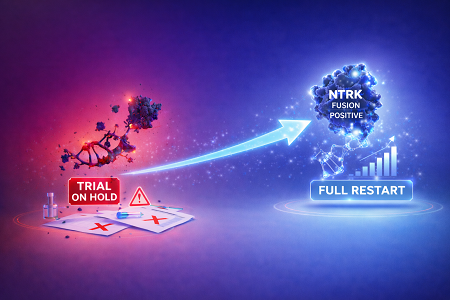
Situation
A US-based biotechnology company appointed Pivotal S.L.U. to take over EU operations for a Phase 1/2 trial investigating a novel TRK inhibitor in patients with NTRK-fusion-positive advanced or metastatic solid tumors.
The study had previously been managed by another Global CRO, and the sponsor required a rapid and seamless transition to prevent further delays in sites activation and patient enrollment.
By the time of the transition in mid‑March 2022, initial regulatory approvals had already been obtained from most of the participating EU countries between September 2021 and January 2022. However, the former CRO had not initiated any sites, and the existing approvals did not allow enrollment under the sponsor’s updated development strategy.
Consequently, the sponsor required the submission and approval of a new protocol amendment to enable EU sites to initiate enrollment. Pivotal was therefore mandated to assume full responsibility and recover the program, moving it from stalled activation to the first patient enrolled.

Study Overview

Challenges
Pivtotal inherited a study that presented several operational and timeline risks. The following issues required immediate action.
|
1. Dormant Approvals with No Execution Regulatory approvals had been issued between September 2021 and January 2022. However, these approvals did not allow enrollment under the updated strategy. At the time of the handover in March 2022, no EU site had been initiated. |
|
2. Mandatory Protocol Amendment The sponsor required a new protocol amendment. This amendment had to be submitted and approved in all participating EU countries before sites could start enrollment. |
|
3. Downstream contractual impact The new amendment also required updates to all existing CTAs. As a result, each site needed contractual renegotiation before activation. |
|
4. Extended gap between approval and activation The long delay between initial approvals and operational readiness increased the risk of site disengagement and loss of interest. |
|
5. Multi-country regulatory recovery Each EU country required a customized approach for amendment submission and approval. Timelines were tight, and coordination needed to be precise. |
|
6. Complex stakeholder coordination Sponsor teams, legacy CRO documentation, and local partners required clear alignment. This alignment needed to happen quickly to restore study control and momentum. |
Solution
Pivotal implemented a structured recovery and transition plan that focused on converting regulatory status into operational execution.
Following the initiation of the transition, Pivotal led the regulatory recovery strategy, which included preparing and submitting the required protocol amendment while reestablishing site readiness and investigator engagement.
Weekly governance meetings, micromanagement at the country level, and disciplined planning enabled the study to progress from stalled approvals to active enrollment.
Regulatory Recovery:
Operational Execution:
Results
Pivotal successfully rescued and relaunched the EU portion of this clinical trial through disciplined project management, regulatory recovery, operational execution, and strong multi-stakeholder coordination.
Key achievements:
Conclusion
The successful rescue of this study demonstrates Pivotal’s ability to recover complex clinical programs in which regulatory progress has not translated into execution.
By spearheading a mandatory protocol amendment, converting dormant approvals into active sites, and enrolling the first EU patient, Pivotal executed a disciplined, high-quality relaunch.
This reestablished the study’s credibility, restored the sponsor’s confidence, and secured a sustainable path forward for this critical oncology development program.

La mejor actitud que podemos adoptar es la de trat...

The research team observed changes in head circumf...
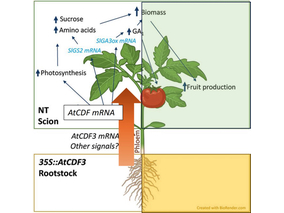
AtCDF3 gene induced greater production of sugars a...

En nuestro post hablamos sobre este interesante tipo de célula del...

A paper published in Alzheimer’s & Dementia: The Journal of the Alzh...