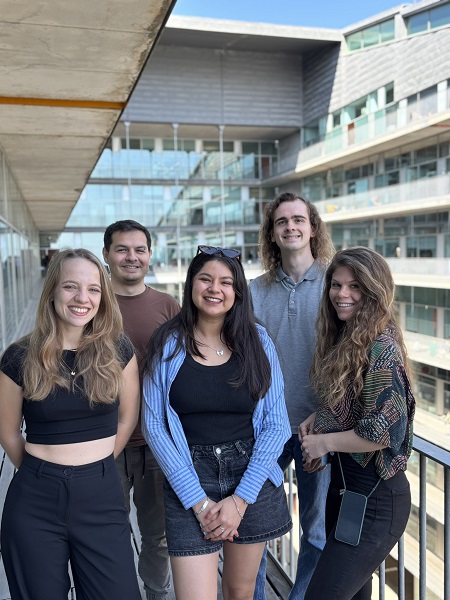
The Centre for Genomic Regulation (CRG) in Barcelona has secured five highly competitive doctoral fellowships from ”la Caixa” Foundation’s INPhINIT programme.
During a ceremony at Barcelona’s CosmoCaixa science museum on 18 March 2025, representatives from ”la Caixa” emphasised that the goal of the INPhINIT programme is to retain and attract top international talent, fostering transformative projects in life sciences, physics, engineering, mathematics, and more.
Every year, ”la Caixa” Foundation commits over 21 million euros to funding early- and mid-career researchers, underlining the strategic importance of science for societal wellbeing and innovation. “These fellowships aren’t just an individual opportunity for each researcher; they’re an investment in the future of our communities,” said the foundation’s General Director, Josep Maria Coronas, at the fellowship award ceremony.
Each doctoral fellowship comes with funding worth approximately 161,200 euros over four years, positioning them among the most competitive in Europe. Below is a closer look at the CRG’s five innovative ideas that could shape our understanding of evolution, conservation, ageing, cancer, and human genetics.
Using Genomics to Safeguard Biodiversity
In our rapidly changing world, over 46,300 species face extinction (IUCN, 2024). For PhD fellow Paulina Nuñez, based in Mafalda Dias and Jonathan Frazer’s lab, the question is how best to predict if and when endangered populations may cross the point of no return. Nuñez’s approach focuses on the concept of genetic load, essentially the burden of harmful mutations that accumulate in small or shrinking populations.
Her work will develop computational models, bolstered by the latest deep-learning techniques, to classify and interpret variants that may be pathogenic in non-human species. By integrating information from across the tree of life, Nuñez aims to identify which mutations may be truly detrimental.
The implications are vast: more precise genetic risk assessments could guide conservationists on where to invest their efforts and resources, improving our ability to safeguard biodiversity in a rapid and constantly-changing world.
Tracking how Blood Changes with Age
Blood is life-sustaining. It also has its own ageing story, one shaped by intricate changes at the level of blood stem cells. PhD researcher Martina Braun in Lars Velten’s lab is developing a technique called EPI-Clone to map the lineage of hematopoietic stem and progenitor cells (HSPCs) as people get older.
Rather than relying on artificial genetic modifications, EPI-Clone traces epimutations, heritable but non-genetic changes in DNA, to follow how different stem cell clones grow and compete over time.
By applying EPI-Clone to healthy donors spanning different ages, Braun hopes to reveal the fundamental dynamics of blood formation and how these dynamics shift as the body grows older. She also plans to delve into clonal hematopoiesis of indeterminate potential (CHIP), a condition in which particular stem cell clones begin to dominate for reasons still poorly understood. Ultimately, her work offers a new lens on how our blood ages and whether we can intervene to slow or prevent age-related illnesses.
Climbing the ‘Foggy Peaks’ of Evolution
One way to picture evolution is as if blindfolded hikers were trying to climb the tallest mountain in total fog, continuously stepping upwards but not knowing exactly where the summit lies. This vivid analogy drives PhD student Kye Hunter in Nora Martin’s group, who investigates how populations evolve in “fitness landscapes.” Fitness landscapes represent the network of possible DNA sequences, each with its own fitness value, linked through simple genetic mutations.
The crux of Hunter’s research is mapping out these landscapes, for example figuring out how many fitness peaks exist and how likely populations are to land on the tallest of these peaks. He will test theoretical models but also match them against real-world data sets that are increasingly available thanks to advances in genomic sequencing. By understanding the underlying structure of these fitness landscapes, Hunter’s work could illuminate the hidden paths populations can traverse in their evolutionary journeys and help predict how they might adapt or fail.
Untangling Structural Variation in Our Genomes
Hidden throughout our genomes are large-scale insertions, deletions, and other rearrangements that can shape everything from basic biological function to disease susceptibility.
But pinpointing these structural variants (SVs) and their functional consequences, particularly in repetitive sections of the genome, has long been a challenge with traditional short-read sequencing techniques. PhD student Jesús Emiliano Sotelo in Bernardo Rodríguez-Martín’s lab is harnessing the capabilities of long-read sequencing technology, such as Oxford Nanopore, to tackle this problem head-on.
His project involves building new techniques which can more accurately identify and classify SVs in human genomes, including notoriously tricky repetitive regions that cover around half of our DNA. Sotelo’s next step is to directly link these structural changes to their impact on RNA transcripts. By marrying these different types of data from large-scale human genomics projects, Sotelo aims to provide clarity on how structural variants alter gene expression, work that could help us decode everything from inherited disorders to human’s predisposition to cancer.
Cracking Breast Cancer’s Mechanical Code
Breast cancer remains a leading cause of cancer-related death worldwide, with over 90,000 lives lost each year in the European Union alone. PhD fellow Giulia Soggia, supervised by Adel Al Jord, is approaching the problem from a fresh angle: she is investigating a hidden mechanical mechanism within cells that might be critical for tumour progression.
Soggia’s preliminary findings suggest that the cytoskeleton physically agitates the nucleus in cancer cells to potentially disrupt or reshape genetic messages. Using a blend of cell biology, biophysics, and advanced imaging, she aims to chart how this mechanical mechanism evolves from healthy breast cells to progressively cancerous ones. Ultimately, her project may reveal entirely new vulnerabilities in cancer cells, offering potential early-detection methods or treatment strategies that target the physical underpinnings of tumorigenesis.

La mejor actitud que podemos adoptar es la de trat...

The research team observed changes in head circumf...

AtCDF3 gene induced greater production of sugars a...

En nuestro post hablamos sobre este interesante tipo de célula del...

Telum Therapeutics, a biotechnology company leveraging proprietary met...