A preclinical study led by the Vall d’Hebron Institute of Research (VHIR), in collaboration with the Institute for Advanced Chemistry of Catalonia (IQAC-CSIC), has proposed the use of magnetic nanoparticles and hyperthermia to improve the treatment of pancreatic cancer with adenocarcinoma. The aim is to penetrate the desmoplastic stroma, the layer surrounding these cancers that acts as a barrier against chemotherapy. Successfully crossing this matrix to reach the tumour directly is vital to improve the survival rate of pancreatic cancer patients, which currently stands at just 16% after five years. The research, conducted together with the Biomedical Research Centre in Bioengineering, Biomaterials and Nanomedicine (CIBER-BBN) and other national and international research centres, has been published in Applied Materials & Interfaces. Based on the results, a clinical trial led by the Vall d’Hebron Institute of Oncology (VHIO) targeting patients with locally advanced pancreatic cancer has now been launched.
This research is part of the NoCanTher project, which involves professionals from various disciplines across eleven national and international centres. The NoCanTher Consortium, funded by Horizon 2020, aims to find innovative strategies for treating pancreatic cancer with adenocarcinoma through the use of magnetic nanoparticles. It is estimated that 20% of pancreatic cancer patients have this condition, characterised by non-metastatic tumours that cannot be surgically resected. Currently, the only treatment option is palliative chemotherapy.
The project involves developing iron-based magnetic nanoparticles, which, when exposed to an alternating magnetic field, generate heat (magnetic hyperthermia). This heat can be used to make the desmoplastic stroma surrounding tumours more permeable, allowing chemotherapy to penetrate the malignant cells. This enhances the treatment’s effectiveness, potentially destroying the tumour cells.
The study shows that when the nanoparticles are injected directly into the tumour, the hyperthermia generated reduces the tumour volume and causes physical changes in the tumour that facilitate the entry of chemotherapy. “This study is significant because the combination of hyperthermia and chemotherapy is synergistic,” explains Ibane Abasolo, IQAC-CSIC researcher and lead author of the study. “Hyperthermia makes the tumour more permeable, and chemotherapy becomes more effective because it can accumulate in greater amounts in tumours that have been pre-treated with hyperthermia.”
The study also demonstrates that hyperthermia is safe even when combined with chemotherapy. In addition to testing the treatment’s efficacy in humans, the researchers will use the approved clinical trial to collect blood samples from patients and determine if this therapy reduces the number of circulating tumour cells, especially tumour stem cells, which can generate new cancer cells and metastasise. Although this is a relatively new field of research, for cases where external beam radiotherapy may cause higher toxicity rates, this approach could offer a viable treatment option for patients, particularly those for whom standard treatments are ineffective.
Reference: Z. V. Díaz-Riascos, M. Llaguno-Munive, N. Lafuente-Gómez, Y. Luengo, S. Holmes, J. Volatron, O. Ibarrola, S. Mancilla, F. Sarno, J. J. Aguirre, S. Razafindrakoto, P. Southern, F. J. Jerán, A. Keogh, G. Salas, A. Prina-Mello, J. C. Lacal, A. Del Pozo, Q. A. Pankhurst, M. Hidalgo, F. Gazeau, Á. Somoza, S. Schwartz Jr, I. Abasolo. Preclinical Development of Magnetic Nanoparticles for Hyperthermia Treatment of Pancreatic Cancer. Applied Materials & Interfaces. DOI: 10.1021/acsami.4c16129
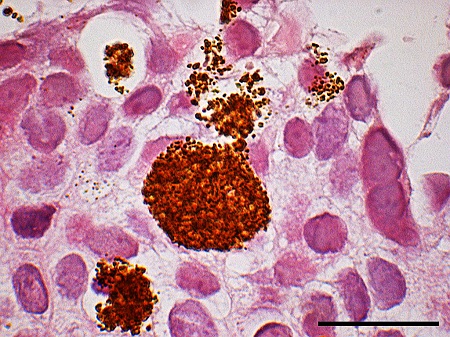
Image: Magnetic nanoparticles surrounded by pancreatic cancer cells (light and dark pink) / Ibane Abasolo

La mejor actitud que podemos adoptar es la de trat...

The research team observed changes in head circumf...
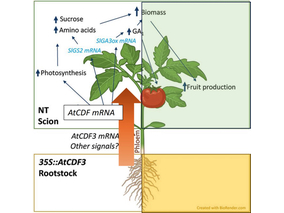
AtCDF3 gene induced greater production of sugars a...
En nuestro post hablamos sobre este interesante tipo de célula del...

Telum Therapeutics, a biotechnology company leveraging proprietary met...