Carboranes are molecules composed of carbon, boron and hydrogen atoms that are proving to have applications of great interest in chemistry, materials science and biomedicine. They are being used, for example, in the fight against cancer through boron neutron capture therapy (BNCT), an experimental form of radiotherapy against malignant tumours that is highly selective at the cellular level. These compounds, which are highly stable at high temperatures and under radiation, possess unique electronic properties and can interact with various biochemical molecules. However, chemically modifying them to expand their potential properties and applications remains a challenge.
Now, teams from the University of Barcelona and the University of Girona, in collaboration with Nanjing University (China), have developed an innovative method for selectively modifying these boron-rich molecular clusters. The paper, published in the journal Angewandte Chemie International Edition, opens up new opportunities for applications in cancer therapy, chemical sensors and advanced luminescent materials.
The study is led by experts Jordi Poater, an ICREA researcher at the Department of Inorganic and Organic Chemistry at the Faculty of Chemistry and a member of the Institute of Theoretical and Computational Chemistry (IQTCUB) at the UB, and Miquel Solà, from the Institute of Computational Chemistry and Catalysis at the University of Girona, together with Hong Yan, from Nanjing University, who carried out the synthesis.
From the fight against cancer to luminescent materials
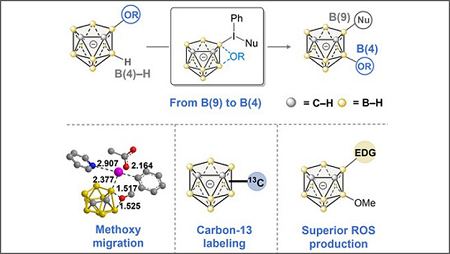
Carboranes have a polyhedral cage structure (cluster) and contain many boron-hydrogen (B-H) bonds that are very similar to one another, which makes them difficult to modify chemically. The team has now developed a metal-free strategy that uses hypervalent iodine reagents to selectively activate these bonds under mild conditions.
In the study, the experts discovered an unprecedented interaction between the boron cage and iodine that enables the formation of new boron-oxygen, boron-nitrogen, boron-sulphur and boron-phosphorus bonds. These results build on the findings presented in a previous study (Chinese Chemical Letters, 2025), which identified a new migration process within the boron cage that enables the functionalization of positions previously inaccessible by conventional methods.
“These findings provide chemists with a new and versatile tool for designing functional boron-based molecules with great potential impact in medicine and materials science,” says Professor Jordi Poater, who led the theoretical studies that were crucial in explaining how these reactions occur and why they exhibit such high selectivity.
The new methodology has been used to prepare boron-containing compounds with promising applications, such as new agents for boron neutron capture therapy (BNCT) or luminescent materials capable of detecting oxygen and generating reactive oxygen species.
References: Zhang, Ping; Anufriev, Sergey A.; Lu, Changsheng; Tu, Deshuang; Poater, Jordi; Solà, Miquel; Yan, Hong. «Migration at Boron Cage for Selective B–H Functionalization of nido-Carboranes». Angewandte Chemie International Edition, March 2026. DOI: 10.1002/anie.8959071.

La mejor actitud que podemos adoptar es la de trat...
The research team observed changes in head circumf...
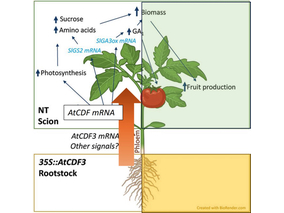
AtCDF3 gene induced greater production of sugars a...
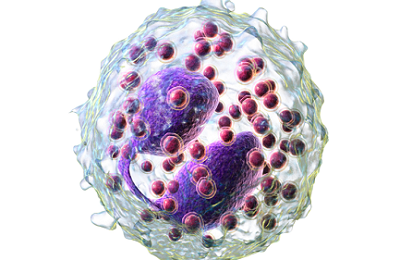
En nuestro post hablamos sobre este interesante tipo de célula del...
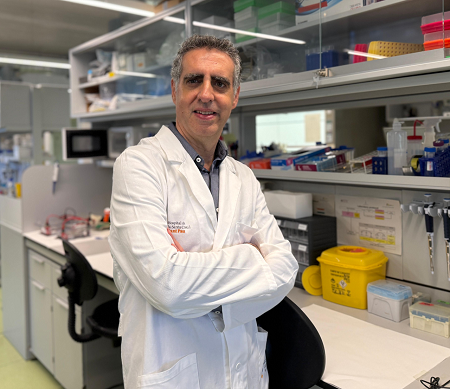
Acute myeloid leukemia (AML) does more than infiltrate the lungs: it a...