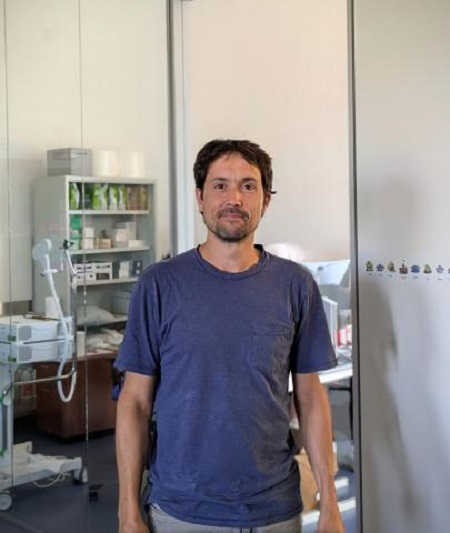
An international team of researchers, led by Jaime Ibáñez, a researcher at I3A, the Aragon Engineering Research Institute of the University of Zaragoza, and the Aragon Health Research Institute (IIS Aragón), proposes a new line of work arguing that it is possible to develop non-invasive technologies to read brain signals using muscle sensors . A new way of approaching and understanding the human brain, doing so from the muscles. A work that has just been published in the journal Nature Biomedical Engineering.
As Jaime Ibáñez explains, "Our muscles not only execute the commands they receive from the brain, they also reflect various sources of information they receive from multiple regions of the nervous system. We can take advantage of this to access brain activity without using invasive methods."
The technologies used to date to directly measure central nervous system activity are limited by their resolution, sensitivity to interference, and invasiveness. Advances in muscle sensors and artificial intelligence allow for highly accurate, real-time decoding of spinal motor neuron activity.
The central focus of this article ("Peripheral Neural Interfaces for Reading High-Frequency Brain Signals" ) is the analysis of the activity of these spinal motor neurons, which act as the last link in the nervous system before a command reaches the muscle. These neurons receive signals from different areas of the brain and spinal cord, and their activation pattern is directly and measurably reflected in the muscles.
The research team argues that peripheral neural connections using muscle sensors are a promising, noninvasive approach for estimating central nervous system neural activity that reaches motor neurons but does not directly modulate force production.
Since at least some of the information reaching the nervous system's output is known to originate in regions of the central nervous system, such as the cortex, recording from muscle tissue could allow for a new type of human interface not only with the peripheral nervous system but also with the central nervous system, according to the scientific article.
"If successfully developed, this technology would offer multiple theoretical advantages over current technologies. It would be a noninvasive, portable, highly robust, safe, and accessible alternative, given its potentially low cost and usability outside of clinical settings," says researcher Jaime Ibáñez.
The authors base their work on various principles, such as the ability of muscles to transmit multiple sources of information , the close relationship between brain activity and that measured in the muscles, and the possibility of decoding neuronal activity using advanced signal processing and artificial intelligence techniques.
The article also identifies current limitations and challenges that must be overcome, such as the need for muscle activation to extract useful information, the difficulties in decoding neural information in dynamic movements, and the still limited understanding of the type of information exchanged between muscles and the brain. It presents a theoretical perspective based on existing scientific evidence and proposes directions for future research, not new experimental results.
Authors:
· Jaime Ibáñez, Biomedical Signal Interpretation and Computational Simulation research group at I3A Unizar and IIS Aragón.
· Blanka Zicher, Etienne Burdet, Dario Farina, Department of Bioengineering, Imperial College, London.
· Carsten Mehring, Faculty of Biology, University of Freiburg, Freiburg im Breisgau, Germany.
· Stuart N. Baker, Institute of Neuroscience, Newcastle University, Newcastle upon Tyne, UK.
Access the full article: “Peripheral neural interfaces for reading high-frequency brain signals” https://www.nature.com/articles/s41551-025-01445-1
Funding: This work has been supported, among others, by a Ramón y Cajal grant (RYC2021-031905-I) funded by the Ministry of Science, Innovation and Universities with NextGeneration funds from the European Union, and by the European Research Council (ERC) through a Starting Grant project (ECHOES project, ID: 101077693).

La mejor actitud que podemos adoptar es la de trat...

The research team observed changes in head circumf...

AtCDF3 gene induced greater production of sugars a...

En nuestro post hablamos sobre este interesante tipo de célula del...

Telum Therapeutics, a biotechnology company leveraging proprietary met...