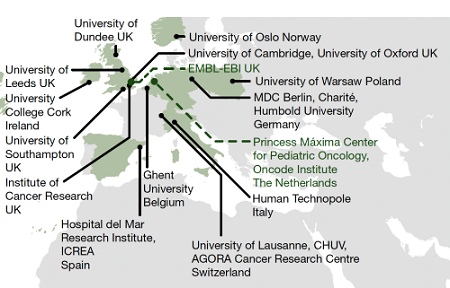
The TransCODE consortium, of which the Hospital del Mar Research Institute is the only research centre in Spain to be a member, has just published a new article that advances knowledge of the so-called dark genome, a part of the human genome that has not been studied and whose function is unknown. The journal Nature publishes the study, in which it designates thousands of previously unannotated proteins as peptideins.
Dr Mar Albà, ICREA professor and director of the Biomedical Informatics Research Programme at the Hospital del Mar Research Institute (HMRIB), is one of the authors of the study. She highlights the importance of analysing this part of the genome, noting that "some of these proteins may have important functions in the cell. In addition, even for those that are not functional, they are a reservoir of new proteins from an evolutionary point of view".
The researchers started from a list of more than 7,000 DNA sequences suspected of coding for dark proteins. They have been studied and identified thanks to the development of specific techniques to sequence the RNA fragments protected by ribosomes, and have been validated by proteomics. These are proteins of recent origin from an evolutionary point of view, very small and with no known function. For all these reasons, they are not included in databases.
The new term, peptideins, is a combination of the words peptide, a short amino-acid fragment, and protein. Its creation allows them to be included in databases, thus facilitating possible new studies of their functions. In this regard, Dr Albà explains that "one line of research we want to pursue based on these results is to see which of them show patterns of phylogenetic conservation that indicate functionality. To do this, we plan to compare the dark proteomes of closely related species". Some of these peptideins have been linked to diseases, such as childhood cancers, and to basic cellular functions.
Reference article: Deutsch, E.W., Kok, L.W., Mudge, J.M. et al. Expanding the human proteome with microproteins and peptideins. Nature (2026). https://doi.org/10.1038/s41586-026-10459-x

La mejor actitud que podemos adoptar es la de trat...

The research team observed changes in head circumf...

AtCDF3 gene induced greater production of sugars a...

En nuestro post hablamos sobre este interesante tipo de célula del...

Telum Therapeutics, a biotechnology company leveraging proprietary met...