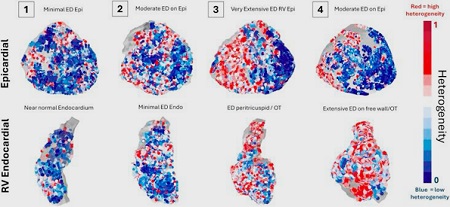
An international team of researchers, with the prominent participation of the EP Analytics Lab group at ITACA Institute of the Universitat Politècnica de València (UPV), has developed an innovative cardiac mapping tool capable of identifying hidden electrical abnormalities.
This technique has proven effective in locating the abnormal substrate in patients with ventricular tachycardia and arrhythmogenic cardiomyopathy (ACD), a hereditary disease that can cause severe ventricular arrhythmias and increase the risk of sudden death.
In their studies, published in the scientific journal Heart Rhythm, the researchers present the Vector Field Heterogeneity (VFH) metric, a new indicator designed to quantify local propagation heterogeneities in the heart's electrical signals.
‘This metric allows us to identify sites with abnormal electrical conduction, related to scarring, which in turn can behave as critical functional mechanisms, as in the case of ventricular tachycardia (VT). Its implementation in electroanatomical mapping systems would provide a more accurate tool for locating them,’ says Francisco Castells, an ITACA Research participant in the study.
In this sense, this new technique provides a clearer indication of the location of the heart’s electrical problem.
“It not only detects abnormalities in scars or critical zones for the onset of arrhythmias but also uncovers hidden signals in areas that appeared healthy using conventional methods. Even in tissue close to damaged areas, which appeared to be fine, we found an electrical disorder that gives us a more complete picture of the heart disease,’ adds José Millet, also a researcher at ITACA.
For all these reasons, the authors emphasise that the VFH metric complements current cardiac mapping techniques and could become a valuable marker for improving catheter ablation procedures.
‘This work represents a step towards more effective treatments, with a direct impact on the survival and quality of life of patients with arrhythmogenic cardiomyopathy,’ say researchers at the UPV research centre.
The role of ITACA-UPV
Specifically, the EP Analytics Lab group has played a key role thanks to their expertise in bioelectromagnetics and advanced biomedical signal processing, successfully translating a complex mathematical concept into a tool with real clinical applications.
ITACA researchers Gema Cabero, Elisa Ramírez, Paco Castells, and José Millet have participated in the study, in collaboration with teams from London, Zurich, Madrid and Granada, highlighting the importance of international cooperation in tackling diseases with a high social and health impact.
Finally, the research team emphasises the importance of studies with larger cohorts and long-term follow-up, as well as the feasibility of incorporating this approach into navigation systems to facilitate informed decision-making during electrophysiological interventions.
Reference
Johanna B Tonko, Samuel Ruipérez-Campillo, Gema Cabero-Vidal, Eva Cabrera-Borrego, Caroline Roney, Juan Jiménez-Jáimez, José Millet, Francisco Castells, Pier D Lambiase. Vector field heterogeneity as a novel omnipolar mapping metric for functional substrate characterisation in scar-related ventricular tachycardias. Hearth Rhythm 2025.
https://www.heartrhythmjournal.com/article/S1547-5271(24)03531-8/fulltext
Johanna B. Tonko, Gema Cabero-Vidal, Samuel Ruipérez-Campillo, Eva Cabrera-Borrego, Cristina Lozano, Elisa Ramírez, Javier Moreno, Pablo Sánchez-Millán, Anthony Chow, Juan Jiménez-Jáimez, José Millet, Francisco Castells, Pier D. Lambiase. Endo–epicardial electrical disarray in arrhythmogenic cardiomyopathy with ventricular arrhythmias. Heart Rhythm 2025.
https://www.heartrhythmjournal.com/article/S1547-5271(25)02858-9/fulltext

La mejor actitud que podemos adoptar es la de trat...

The research team observed changes in head circumf...

AtCDF3 gene induced greater production of sugars a...

En nuestro post hablamos sobre este interesante tipo de célula del...

Telum Therapeutics, a biotechnology company leveraging proprietary met...