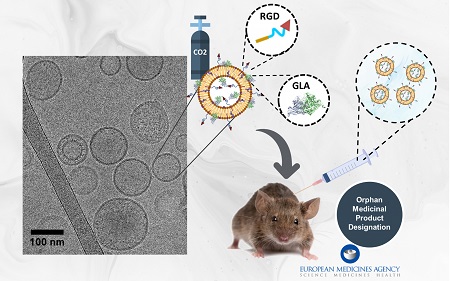
An international research team led by the Institute of Materials Science of Barcelona (ICMAB-CSIC) and CIBER-BBN, with the collaboration of the Institute for Advanced Chemistry of Catalonia (IQAC-CSIC), has developed a new therapy based on nanotechnology called nanoGLA for the treatment of Fabry disease. The new therapeutic solution has shown remarkable efficacy in preclinical studies. The study was published in Science Advances in open access.
Fabry disease is a rare genetic disorder caused by a deficiency of the enzyme GLA (alpha-galactosidase A), which leads to the accumulation of fatty substrates (mainly globotriaosylceramide or Gb3) in cells, with severe effects on various organs. The nanoGLA therapy, based on the use of peptide-targeted nanoliposomes, effectively delivers the deficient enzyme GLA, encapsulated in the nanoliposomes, to the organs most affected by this disease. The researchers have managed to produce nanoGLA with the necessary quality and quantity for preclinical testing, as well as for advancing into clinical phases.
In studies with mouse models of Fabry disease, nanoGLA demonstrated improved efficacy compared to therapies using the unencapsulated enzyme, showing effectiveness in affected organs, including the brain, a key milestone that current therapies do not achieve. These results highlight the potential of nanoGLA to address both the systemic and cerebrovascular manifestations of Fabry disease.
In recognition of the importance of this innovation, the European Medicines Agency granted nanoGLA orphan drug designation (Orphan Medicinal Product Designation) in 2021, a crucial step in driving its development.
This breakthrough has been made possible through collaboration between researchers from several international institutions, including the Institute of Materials Science of Barcelona (ICMAB-CSIC), CIBER-BBN, Vall d’Hebron Research Institute (VHIR), companies such as Nanomol Technologies SL and Leanbio SL, the Advanced Chemistry Institute of Catalonia (IQAC-CSIC), the Institute of Biotechnology and Biomedicine (IBB-UAB), and international collaborators such as the Joanneum Research-Institute for Biomedical Research and Technologies (HEALTH) (Austria), Technion-Israel Institute of Technology (Israel), Guangdong-Technion Israel Institute of Technology (China), Aarhus University (Denmark), and Labcorp Drug Development (UK).
Elisabet González, ICMAB researcher and one of the lead authors of the article, explains: “The new nanoGLA formulation represents a promising opportunity for Fabry disease patients, especially in addressing the neurological manifestations of the disease, a limitation that current therapies cannot overcome. Our goal is to develop safer and more effective treatments by harnessing the potential of nanotechnology.”
These results, obtained within the framework of the European project Smart4Fabry, funded by the European Union’s Horizon 2020 research and innovation program, have greenlighted the continued pharmaceutical development of nanoGLA toward clinical phases with human patients. The European Commission, through the EU Phoenix and Nano4Rare projects, has provided the necessary funding to complete the preclinical phase and obtain approval to begin the clinical phase.
ICMAB-CSIC Communication
Targeted nanoliposomes to improve enzyme replacement therapy of Fabry disease. Judit Tomsen-Melero, Marc Moltó-Abad, Josep Merlo-Mas, Zamira V. Díaz-Riascos, Edgar Cristóbal-Lecina, Andreu Soldevila, Thomas Altendorfer-Kroath, Dganit Danino, Inbal Ionita, Jan Skov Pedersen, Lyndsey Snelling, Hazel Clay, Aida Carreño, José L. Corchero, Daniel Pulido, Josefina Casas, Jaume Veciana, Simó Schwartz Jr., Santi Sala, Albert Font, Thomas Birngruber, Miriam Royo, Alba Córdoba, Nora Ventosa, Ibane Abasolo, and Elisabet González-Mira Science Advances 13 Dec 2024, Vol 10, Issue 50, DOI: 10.1126/sciadv.adq4738

La mejor actitud que podemos adoptar es la de trat...

The research team observed changes in head circumf...
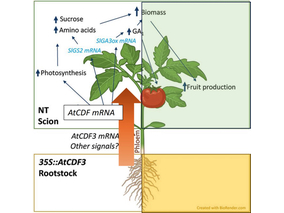
AtCDF3 gene induced greater production of sugars a...
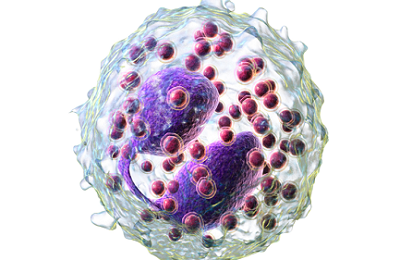
En nuestro post hablamos sobre este interesante tipo de célula del...

Telum Therapeutics, a biotechnology company leveraging proprietary met...