Paragangliomas and pheochromocytomas are rare neuroendocrine tumors, occurring in only 3 to 8 cases per million people. They can develop in the head, neck, torso, or adrenal glands, and may spread to other organs. Approximately half of these tumors are linked to inherited genetic mutations. Identifying these mutations enables healthcare professionals to screen family members who may carry the same alteration, allowing for early diagnosis. But unravelling the genetic complexity of paragangliomas and pheochromocytomas is not straightforward.
To date, around 25 genes associated with the disease have been identified, both in hereditary and sporadic forms. The hereditary endocrine cancer group at the National Cancer Research Centre (CNIO), a pioneering world-leading institute in the study of these tumours, has identified five of the genes involved in the development of paragangliomas and pheochromocytomas over the past decade.
Their new study analyses in depth the genomics of 26 women with head and neck paragangliomas with no known mutations. The findings improve the classification of these tumours and suggest a new gene that might be causing the disease.
Research reveals even greater genetic complexity than expected and opens up new pathways for personalised diagnosis and treatment. The study is published in Genes and Disease, with Alberto Cascón as the lead author and Sara Mellid as the first author.
The largest repository of samples
Since research into these tumours began at CNIO in 2000, the team has established a registry of nearly 1,500 index patients (including both families and individual cases), as well as the largest repository of patient samples in Spain, with contributions from other European countries, the United States and Canada. This is an invaluable resource, as collecting data from a large number of patients is one of the main challenges faced by researchers studying rare diseases.
In fact, through collaborations with centres around the world, the CNIO group led by Mercedes Robledo has completed the largest ever genomic study on metastatic pheochromocytoma – a study that allows teams to identify patients at higher risk of metastasis, and those who would respond to immunotherapy.
Research into these rare cancers is crucial for those affected and provides valuable information to understand many other types of cancer, as shown by the group’s previous work.
Non-specific symptoms
Paragangliomas are tumours of the paraganglia, groups of cells in the nervous system that are distributed around the head, neck, chest and abdomen. Pheochromocytomas are paragangliomas found in the adrenal glands. “Those of us who study them consider them the same disease,” Cascón says.
The symptoms are non-specific: high blood pressure, headaches, excessive sweating, dizziness, extreme paleness… As a result, patients often see many specialists before receiving the correct diagnosis, which is usually made by an endocrinologist through imaging or by detecting high levels of catecholamines—hormones produced by the adrenal glands—in urine or blood.
A candidate new gene that promotes these tumours
Head and neck paragangliomas have a different genetic profile than pheochromocytomas and paragangliomas in other locations, and have fewer disease-promoting mutations. Furthermore, head and neck paragangliomas without known mutations are more common in women.
Cascón explains: “In this study, we performed a multi-omics analysis of 26 head and neck paragangliomas in women without known mutations, which allowed us to classify the tumours into two distinct molecular subgroups: ‘SDH-like type’, with characteristics similar to tumours with mutations in the SDH genes; and ‘DNMT3A-like type’.”
In the latter, the group found, among other alterations, somatic mutations in the STAG2 gene, “suggesting that this could be a new gene that promotes these tumours,” says Cascón.
These findings could have important implications for clinical follow-up, genetic counselling and the development of new targeted therapies for patients with head and neck paragangliomas without known mutations, especially among women.
Funding
This research has been funded by the Carlos III Health Institute (ISCIII), co-financed by the European Regional Development Fund (ERDF) and Fundación Paradifference. Sara Mellid received the “University Teacher Training – FPU” grant from the Department for Science, Innovation and Universities.
Reference article: Sara Mellid, Eduardo Caleiras, Ángel M. Martínez-Montes, Alicia Arenas, Scherezade Jiménez, María Monteagudo, Rocío Letón, Roberta Radu, Ruth Álvarez-Díaz, Ester Arroba, Alberto Diaz-Talavera, Natalia Martínez-Puente, Cristina Álvarez-Escolá, Marta Pineda, Milagros Balbín, Fátima Al-Shahrour, Cristina Rodriguez-Antona, Cristina Montero-Conde, Luis J. Leandro-García, Emiliano Honrado, Miguel Soria-Tristán, Mercedes Robledo, A. Cascón, Molecular profiling unveils genetic complexity and identifies potential new driver mechanisms in head and neck paragangliomas, Genes & Diseases, 2025, 101705, ISSN 2352-3042, https://doi.org/10.1016/j.gendis.2025.101705.
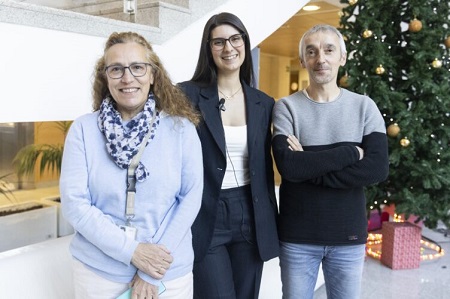
Image: Mercedes Robledo, Sara Mellid and Alberto Cascón, at the Spanish National Cancer Research Centre (CNIO). /Laura M. Lombardía. CNIO

La mejor actitud que podemos adoptar es la de trat...

The research team observed changes in head circumf...
AtCDF3 gene induced greater production of sugars a...
En nuestro post hablamos sobre este interesante tipo de célula del...

Telum Therapeutics, a biotechnology company leveraging proprietary met...