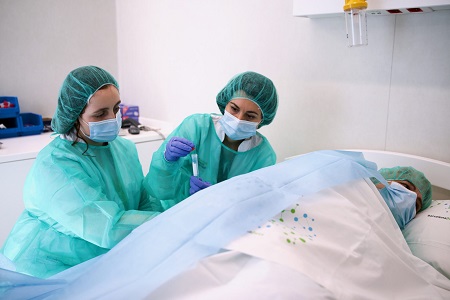
Researchers from the Barcelonaβeta Brain Research Center (BBRC), their research center, together with the Hospital del Mar and its research center (HMRIB), have published in Nature Scientific Reports the results of a standardised protocol to reduce and control headache, the most frequent complication after a lumbar puncture. The lumbar puncture is a key test in neurology because it allows for obtaining cerebrospinal fluid (CSF), a particularly valuable sample in the context of neurodegenerative diseases for analysis biomarkers relevant to brain health and, in particular, to research and clinical practice.
In Alzheimer's research, CSF biomarkers are fundamental to better understanding the disease in its very early stages, even before symptoms appear, and to promote prevention strategies and the development of treatments. In this context, the research team has evaluated a protocol that reduces one of the most common side effects of lumbar puncture: headache, a type of headache that can appear temporarily after a lumbar puncture.
“Lumbar puncture is an essential test for advancing the study of Alzheimer's biomarkers in cerebrospinal fluid, and minimising the discomfort of this test is key. Standardising each step, from hydration to needle type and rest, allows us to reduce headaches and make the procedure more bearable, especially when larger volumes are needed”, explains Dr. Oriol Grau, leader of the BBRC Clinical and Risk Factor Research Group for Neurodegenerative Diseases and co-author of the study.
The key contribution of the ALFA cohort volunteers
The work was carried out with cognitively healthy individuals from the ALFA cohort, promoted by the "la Caixa" Foundation, and was made possible thanks to the participation and commitment of people who, voluntarily, make preventive research into Alzheimer's viable.
The study analysed the 1,147 lumbar punctures performed on 724 participants from the ALFA study, following a standardised protocol that combines:
The results show that, with this protocol, the headache after this test was at 9.6% at 24 hours and 4.7% at 7 days. In people who did have headaches, it was almost always mild pain (95.5% of cases at 24 hours; 87% at 7 days) and there were no reports of severe cases or complications requiring a blood patch (a procedure in which the patient's own blood is injected to seal a possible cerebrospinal fluid leak), or hospitalisation.
“The application of a standardized protocol has made it possible to reduce serious complications to 0 after cerebrospinal fluid extraction after lumbar puncture,” adds Dr. Antonio Montes, head of the Pain Unit at Hospital del Mar and researcher at its research institute and corresponding author of the study.
Because this is an observational study, and does not include a control group,researchers contextualise the improvement of this protocol by comparing its results with existing literature. Specifically, when reviewing three similar studies, the reported post-dural headache rates were 24.8%, 11.9% and 9%at 24 hours; additionally more severe events were reported in those studies, such as hospitalisation (2.5%) or the need for a blood patch (1.4%), while no complications of this type were observed in this study.
“Lumbar puncture is an essential test for advancing the study of Alzheimer's biomarkers in cerebrospinal fluid, and minimising the discomfort of this test is key. Standardising each step, from hydration to needle type and rest, allows us to reduce headaches and make the procedure more bearable, especially when larger volumes are needed”, explains Dr. Oriol Grau, leader of the Clinical and Risk Factors Research Group for Neurodegenerative Diseases at the BBRC and co-author of the study.
The exploratory analysis also found that, at 24 hours, headaches were more frequent in individuals with a history of chronic pain, a low or very high body mass index, and when the puncture was conducted at lower lumbar levels.
“In addition to safety, we care deeply about ensuring that our participants have the best possible experience. A clear, reproducible protocol makes clinical practice easier, improves follow-up, and helps ensure that, if headaches do occur, they can be easily managed with standard measures and without complications,” explains Anna Soteras, Director of BBRC’s Clinical Operations Facility and co-author of the study.
The study stands out for its large sample size, the systematic application of a homogeneous protocol, and a structured follow-up at 24 hours and at 7 days. However, the authors point out that the absence of a control group and the fact that the study was conducted in such a specific context, with a relatively limited age range, may limit the generalisation of the results in other settings and populations.
Improving the tolerability of lumbar punctures is no trivial matter: it is a key condition for being able to continue advancing preventative research. Having more standardised protocols with fewer complications helps reduce fear and makes it easier for more people to agree to undergo this test more confidently. This is particularly relevant, because cerebrospinal fluid provides essential information about Alzheimer's biomarkers, and it allows for earlier and better answers to scientific enquiries which, with the passage of time, may translate into more accurate diagnoses and more effective prevention strategies.

La mejor actitud que podemos adoptar es la de trat...

The research team observed changes in head circumf...

AtCDF3 gene induced greater production of sugars a...
En nuestro post hablamos sobre este interesante tipo de célula del...

Telum Therapeutics, a biotechnology company leveraging proprietary met...