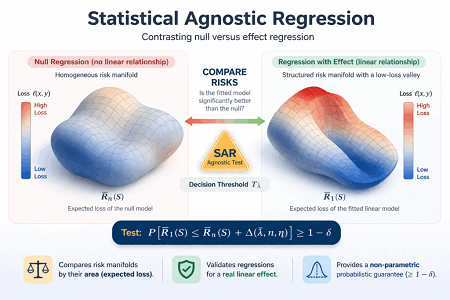
Researchers from the Granada Institute for Biomedical Research (ibs.GRANADA) and the University of Granada have developed a new artificial intelligence tool that allows for more reliable verification of the validity of certain mathematical models used in scientific and biomedical research. The method, called Statistical Agnostic Regression (SAR), helps to determine whether the relationship a model finds between different variables reflects a real pattern or whether it could be due to chance or a poor fit to the data.
Furthermore, this advance has a neuroimaging application accepted by the journal NeuroImage , which analyzes its usefulness in studying Alzheimer's disease. Taken together, these results pave the way for developing more reliable and useful predictive models in medicine, especially in complex areas such as brain image analysis.
Artificial intelligence is increasingly used to analyze vast amounts of data and find patterns that help predict diseases or better understand how they evolve. However, one of its main challenges is that it can sometimes identify relationships that don't actually exist. When this happens, there is a risk of drawing erroneous conclusions if the models are not rigorously tested.
According to Juan Manuel Górriz, a researcher with the TEC15 Nuclear and Molecular Medicine group at ibs.GRANADA, coordinator of the SiPBA TIC 218 group at the University of Granada, and lead author of the study, “one of the main problems with artificial intelligence is that it can detect relationships that do not actually exist. With SAR, we have developed a tool that allows us to rigorously validate these models, reducing false positives and increasing confidence in the results.”
One of the main advantages of SAR is that it applies stricter validation than other common methods. In practice, this means that it only considers a relationship between variables reliable when there is sufficient statistical evidence. Although this approach is more demanding, it is especially important in biomedical research, where it is not enough for a model to appear to work well: it is also necessary to ensure that its results are robust and reproducible.
The research team has found that some common machine learning methods can produce overly optimistic results, especially when working with limited data. In contrast, SAR better reduces the risk of false positives—that is, of validating a relationship that doesn't actually exist. This makes it a more conservative, but also more reliable, method.
To demonstrate its usefulness in a real-world case, the researchers applied this method to data from the international ADNI (Alzheimer's Disease Neuroimaging Initiative) project , one of the leading databases for Alzheimer's research. In this context, they analyzed the relationship between clinical variables, such as the MMSE cognitive score , and data obtained from brain imaging. The results indicate that SAR can be particularly useful for validating models in complex fields like neuroimaging, where it is crucial to distinguish between truly robust findings and merely apparent associations.
This advance can contribute to improving the reliability of predictive models used in medicine and, in the future, facilitate better-informed clinical decisions. In the case of Alzheimer's disease, having more robust tools to analyze clinical and neuroimaging data can be of great help in moving towards earlier and more accurate detection of the disease.
The study was developed by researchers from ibs.GRANADA and the University of Granada, with participation from the DaSCI Institute of the University of Granada and the University of Cambridge.
Bibliographic reference:
Gorriz, J. M., Ramirez, J., Segovia, F., Jimenez-Mesa, C., Martinez-Murcia, F. J., & Suckling, J. (2026). Statistical agnostic regression: A machine learning method to validate regression models. Journal of Advanced Research, 80, 503–533. https://doi.org/10.1016/j.jare.2025.04.026
About the group:
The TEC15-Nuclear and Molecular Medicine group , part of the Advanced Therapies and Biomedical Technologies area at ibs.GRANADA, conducts its research in the field of diagnostic imaging and nuclear medicine, with a particular focus on identifying new tracers for cancer diagnosis and evaluating treatment response. Established as a leading group in the technical evaluation of new procedures useful in nuclear medicine, it is part of the CANCER Corporate Research Network. Its lines of work encompass the clinical applications of PET in oncology, nuclear endocrinology and the study of genetic markers in thyroid cancer, neurology, neuropsychology and nuclear psychiatry applied to the central nervous system, as well as the labeling, pharmaceutical development, and quality control of new radiopharmaceuticals. Ultimately, its work centers on promoting innovative diagnostic imaging tools with potential clinical applications in areas such as cancer, neurological diseases, and endocrine disorders.
More information: https://www.ibsgranada.es/grupos-de-investigacion/tec15-medicina-nuclear-y-molecular/

La mejor actitud que podemos adoptar es la de trat...

The research team observed changes in head circumf...
AtCDF3 gene induced greater production of sugars a...
En nuestro post hablamos sobre este interesante tipo de célula del...

Telum Therapeutics, a biotechnology company leveraging proprietary met...