The results published in the prestigious journal Science Immunology pave the way for new strategies to strengthen the immune defense against persistent or severe infections, and modulate the neutrophil response in pathologies such as cancer, cardiovascular diseases or chronic metabolic inflammation.
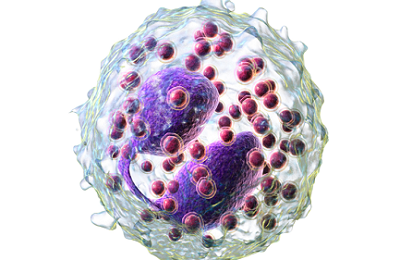
The international research, led by the Center for Molecular Biology of Inflammation at the University of Münster in Germany, involved researchers from the University of Extremadura's (UEx) stress, exercise, aging, and health research program . In the field of immunology, neutrophils play an essential role in the body's initial defense against pathogens. They are the most abundant type of white blood cell in the blood, the first to intervene when there is an infection, inflammation, or other problem; they are effective "soldiers" with a lifespan of only one or two days. Bone marrow is responsible for the constant production and release of neutrophils thanks to hematopoietic progenitor stem cells .
However, if inflammatory signals persist, as occurs in prolonged infections, cancer, stress, or chronic inflammatory diseases, emergency granulopoiesis is activated in the bone marrow to maintain the supply of neutrophils, which are no longer as mature due to increased production. In this context, hematopoietic stem and progenitor cells migrate and settle in secondary organs such as the spleen, a key lymphoid organ of systemic immunity, giving rise to what is known as extramedullary hematopoiesis.
Until now, extramedullary hematopoiesis was considered a secondary response to increase the number of neutrophils when bone marrow is insufficient. This research demonstrates that extramedullary hematopoiesis produces neutrophils that are qualitatively different from those produced by bone marrow and, although immature, are highly active and have greater antimicrobial properties. “It’s not so much a question of increasing the number of neutrophils as it is of their adaptation and differentiation . Hematopoiesis in the spleen will generate neutrophils with different properties and a superior antimicrobial capacity,” emphasizes UEx researcher Miguel Palomino , co-author of this study.
Another of the most important results of the research has been to verify that the spleen pre-activates ( priming ) neutrophils with reinforced antimicrobial pathways through type I interferon signaling, a group of proteins that alert and activate cells against pathogens.
The contribution of the UEx
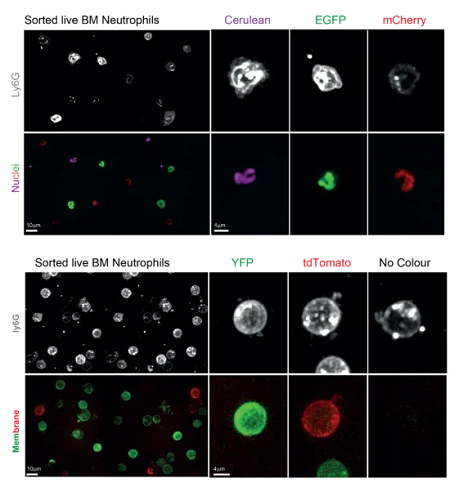
Researchers at the University of Extremadura (UEx) have contributed a powerful and innovative tool to this study: a mosaic mouse model. The mosaic model allows researchers to trace the clonal origin of neutrophils. “This way, we can determine which neutrophils originate from the bone marrow and which from the spleen, enabling us to measure their differences,” explains Palomino. This model allows researchers to study the functional heterogeneity of neutrophils based on their origin and can be applied to the study of cancer, infections, and inflammatory diseases.
“Previously, it was thought that neutrophils always behaved the same way under any circumstances. Now we are seeing that their biology is much more complex, that there is a great deal of functional variability, and this tool we have developed is unique for studying this complexity,” the researcher states. Furthermore, the UEx researchers are also trying to decipher the “when” and “how” that gives rise to this functional diversity in neutrophils, in order to identify subtypes with potentially dangerous or harmful properties in diseases, particularly cardiovascular diseases.
Bibliographic reference: Carlos Silvestre-Roig et al., Divergent granulopoiesis at extramedullary sites safeguards antibacterial host defense. Sci. Immunol.11,eadw7077(2026).DOI:10.1126/sciimmunol.adw7077

La mejor actitud que podemos adoptar es la de trat...

The research team observed changes in head circumf...
AtCDF3 gene induced greater production of sugars a...
En nuestro post hablamos sobre este interesante tipo de célula del...

Telum Therapeutics, a biotechnology company leveraging proprietary met...