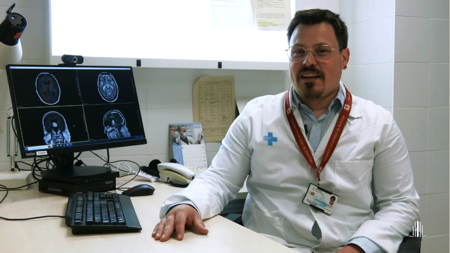
A European study led at a national level by neurosurgeons from the Bellvitge University Hospital and IDIBELL has provided relevant new knowledge on the impact of surgery on the prognosis and recovery of patients with severe haemorrhagic stroke.
The study, called SWITCH, was published on May 15 in The Lancet, one of the most prestigious in the world, and was presented at the European Stroke Organization (ESOC) congress in Basel.
It was led by Dr. Jürgen Bech from Freiburg University Hospital and Dr. Urs Fischer from Inselspital University Hospital Bern. On behalf of the Bellvitge University Hospital and IDIBELL, it has been headed by Dr. José Luis Sanmillán, from the Neurosurgery Service, who is one of the main signatories of the article.
In total, it included 197 patients with severe deep haemorrhagic stroke treated and followed for an average of 9.5 years in hospitals in Belgium, Germany, Finland, France, the Netherlands, Austria, Sweden, Switzerland and Spain.
Unfortunately, there is currently no effective therapy for severe deep haemorrhagic stroke. In this type of stroke, the bleeding and subsequent swelling put pressure on the surrounding brain tissue causing widespread damage to the brain. This often leads to severe disabilities and high mortality.
Treatment options have so far been limited to medications to lower blood pressure and to stop bleeding, which is often not enough.
This study examined the effect of relieving the pressure caused by bleeding by performing a decompressive cranectomy (removal of a part of the skull that is re-implanted once the swelling has subsided). Patients included in the study received either prior standard therapy or standard therapy in combination with decompressive cranectomy.
Six months after the procedure, 44% of patients with neurosurgical intervention and 58% of patients without neurosurgical intervention had achieved maximum neurological damage or death. This implies, statistically, weak evidence for the superiority of surgical therapy, although severe disability and mortality were high in both groups. The study provides more data that allows the selection of the best treatment in each case and opens the door to further research.
The Bellvitge Biomedical Research Institute (IDIBELL) is a biomedical research center created in 2004. It is participated by the Bellvitge University Hospital and the Viladecans Hospital of the Catalan Institute of Health, the Catalan Institute of Oncology, the University of Barcelona and the City Council of L’Hospitalet de Llobregat.
IDIBELL is a member of the Campus of International Excellence of the University of Barcelona HUBc and is part of the CERCA institution of the Generalitat de Catalunya. In 2009 it became one of the first five Spanish research centers accredited as a health research institute by the Carlos III Health Institute. In addition, it is part of the “HR Excellence in Research” program of the European Union and is a member of EATRIS and REGIC. Since 2018, IDIBELL has been an Accredited Center of the AECC Scientific Foundation (FCAECC).

La mejor actitud que podemos adoptar es la de trat...

The research team observed changes in head circumf...
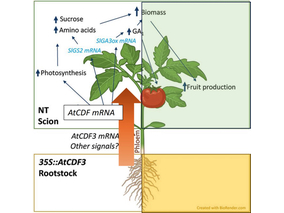
AtCDF3 gene induced greater production of sugars a...
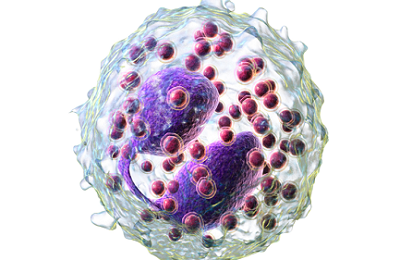
En nuestro post hablamos sobre este interesante tipo de célula del...

Telum Therapeutics, a biotechnology company leveraging proprietary met...