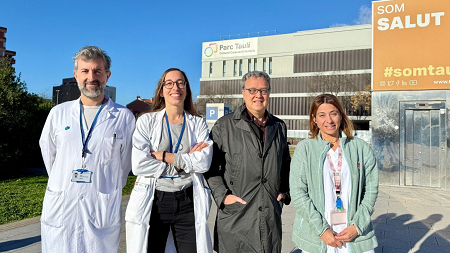
A research team from the Parc Taulí Research and Innovation Institute (I3PT), in collaboration with the Pere Virgili Health Research Institute (IISPV) and the Hospital del Mar Research Institute (IMIM), have identified a clear association between abdominal fat accumulation and premature vascular aging in people with type 1 diabetes without a previous cardiovascular history.
The research was based on a cohort of 179 people with this pathology, all of them evaluated at the Parc Taulí University Hospital under the coordination of José Miguel González-Clemente, endocrinologist at Parc Taulí and head of the diabetes-cardiovascular risk group of the I3PT and of Joan Vendrell, researcher at the IISPV, as part of a CIBERDEM-ISCIII working group.
Despite having good control of glycemia, blood pressure and lipid profile, approximately one 10% of people studied showed signs of premature vascular aging, a key factor in the development of cardiovascular and microvascular complications that directly affect quality and life expectancy.
“In type 1 diabetes, treatment with insulin is essential for controlling blood sugar, but, over the years, may promote gradual weight gain associated with a higher risk of complications", explains González-Clemente. According to the researcher, before we can speak of general obesity, there may already be an accumulation of abdominal fat, especially in the form of visceral fat, which is metabolically active and closely related to the deterioration of the arteries. "This type of fat promotes the loss of arterial elasticity, a process linked to the degradation of elastin, an essential protein of the vascular wall, and can be the basis of complications such as heart attackstroke, circulatory deficits in the lower extremities or the retinal effects, the kidneys and the peripheral nervous system" He says.
The waist-to-height index, a tool to detect early vascular aging
To easily identify people at higher risk of vascular aging, the study focuses on the waist-to-height index, an indicator calculated by dividing the waist circumference by the height, both measurements in centimeters. The data obtained show that a value equal to or greater than 0,56 is associated with accelerated vascular aging, determinate using the pulse wave velocity, a non-invasive technique that allows the quantification of arterial stiffness. “Virtually all people with high pulse wave velocity had this index equal to or greater than 0,56,” highlights González Clemente, who emphasizes that other common indicators, such as body mass index or waist-hip index, do not detect this risk as well.
The results, published in the journal Diabetes Research and Clinical Practice, reinforce the importance of avoiding weight gain and monitoring abdominal fat accumulation as a preventive strategy "Early controlling this index would allow us to act before obesity is established, facilitate better metabolic control and reduce the risk of long-term vascular complications," he concludes.
The researchers point out that the next step will be to validate these results in larger cohorts with longer follow-up. The study also suggests that some drugs used in people with type 2 diabetes to reduce weight They could be useful in people with type 1 diabetes, a field that still lacks sufficient evidence in clinical research.
Study Reference: Llauradó G, Cano A, Giménez-Palop O, Albert L, Pareja R, Fernández-Veledo S, Vendrell J, González-Clemente JM. Insulin resistance and abdominal adiposity discriminate early vascular aging (higher vascular risk) in adults with type 1 diabetes without cardiovascular events. Diabetes Res Clin Pract. 2026 Jan;231:113010. doi: 10.1016/j.diabres.2025.113010. Epub 2025 Nov 19. PMID: 41271109.

La mejor actitud que podemos adoptar es la de trat...

The research team observed changes in head circumf...

AtCDF3 gene induced greater production of sugars a...

En nuestro post hablamos sobre este interesante tipo de célula del...

Telum Therapeutics, a biotechnology company leveraging proprietary met...