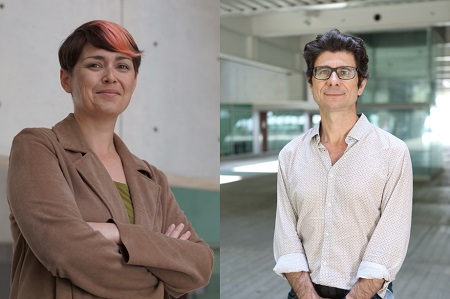
Two researchers at the Centre for Genomic Regulation (CRG) in Barcelona are tackling an urgent question: how can we stop cancer before it spreads? Thanks to new grants from the Spanish Association Against Cancer (AECC), Dr. Sara Sdelci and Dr. Luciano Di Croce hope to transform the way doctors diagnose and treat metastatic disease.
“There’s an unmet need to understand why some tumours relapse and spread while others do not,” says ICREA Research Professor Dr. Di Croce, who received a 96,000-euro award to map the hidden steps that lead to metastasis in colorectal cancer. “We believe the answer lies deep in the organization of the genome itself.” The AECC’s funding will complement a 172,000-euro grant awarded by TRANSCAN-3, part of the European Union’s Horizon 2020 Research and Innovation Programme, bringing the total for Dr. Di Croce’s research efforts to 268,000 euros.
His colleague, Dr. Sdelci, received a 299,675-euro grant to investigate the interplay between metabolism and epigenetics in oestrogen receptor-positive (ER+) breast cancer, the most common subtype of the disease. “What’s exciting,” she says, “is that we’re now realising metabolic enzymes can actually occupy the nucleus of cancer cells, rewriting the instructions that determine how quickly tumours grow or resist treatment. These are new potential targets.”
Colorectal cancer remains one of the leading causes of cancer-related deaths worldwide, with the World Health Organization estimating nearly 2 million new cases each year. Up to 40 percent of patients develop metastatic disease, even if their tumours initially appear localised. Such recurrences often prove difficult to detect before they have spread extensively.
Dr. Di Croce’s project focuses on the elusive seeds of metastasis, which can lie dormant and go undetected for months or even years. The key may be found in the DNA circulating in the bloodstream, also known as circulating tumour DNA (ctDNA). His aim is to create a simple blood test to identify epigenetic changes that arise long before standard imaging can detect a returning tumour.
“These tiny fragments of tumour DNA can hint at which patients are at higher risk,” says Dr. Di Croce. “If we can predict relapse earlier, we can personalize post-surgical treatment. Instead of administering the same chemotherapy to everyone, we could tailor therapies to those who genuinely need them.”
One recent clinical trial suggested that ctDNA testing could spot the presence of metastatic disease up to six months earlier than conventional scans. Detecting these alterations sooner could lower unnecessary treatments for low-risk patients and prompt more aggressive therapy for those at high risk, an approach that could save both lives and resources.
Meanwhile, Dr. Sdelci’s work takes aim at ER+ breast cancer, which affects more than a million women globally each year. Typically, these tumours rely on oestrogen signals to grow, making hormonal treatments the main line of therapy. Despite remarkable strides in blocking oestrogen receptors, many patients eventually experience resistance, causing relapse.
In their lab at the CRG, Dr. Sdelci’s team has uncovered clues that metabolic pathways inside the nucleus, once believed to exist only in the cell’s cytoplasm, may remodel the cell’s epigenetic landscape. Essentially, these metabolic enzymes can switch genes on or off without altering the underlying DNA sequence. This means tumour cells may be adept at dodging targeted drugs.
“These metabolic enzymes don’t just provide energy for cells,” says Dr. Sdelci. “They physically bind to DNA, controlling how genes are expressed. If we can figure out how to break up these nuclear alliances, we might halt the progression of breast cancer.”
With the AECC’s support, her group is working on ways to detect these changes early on, potentially identifying especially aggressive tumours before they adapt and metastasize.
According to worldwide figures, an estimated one in eight women will develop breast cancer at some point in their lifetime, and colorectal cancer remains the second leading cause of cancer death in Europe. If their projects are successful, the contributions of both researchers could make the future of cancer care could look very different: simpler blood tests to detect hidden dangers, and finely tuned therapies that strike at the early signs of metastasis.

La mejor actitud que podemos adoptar es la de trat...

The research team observed changes in head circumf...
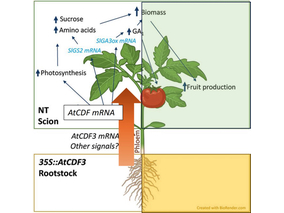
AtCDF3 gene induced greater production of sugars a...
En nuestro post hablamos sobre este interesante tipo de célula del...

Telum Therapeutics, a biotechnology company leveraging proprietary met...