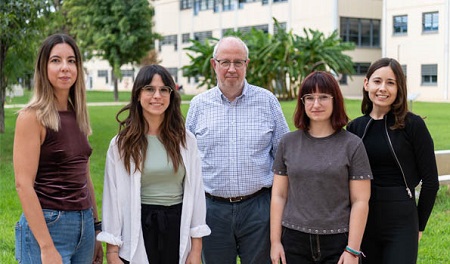
A team from the Universitat Politècnica de València (UPV), belonging to the Interuniversity Institute for Molecular Recognition and Technological Development (IDM), and the CIBER for Bioengineering, Biomaterials and Nanomedicine (CIBER-BBN), the LA Fe Health Research Institute (IIS La Fe), together with the UPV-Príncipe Felipe Research Centre (CIPF) Joint Unit, has developed innovative nanoparticles in the preclinical phase that can locate and eliminate senescent tumour cells, which are responsible for cancer relapses. The work has been published in the journal Biomaterials.
Senescent cells are those that stop dividing but do not die. In cancer cases, although they initially slow down the progression of the tumour, over time, they can generate an inflammatory tumour environment and promote the recurrence of the disease. Until now, drugs known as senolytics have shown some efficacy against these senescent cancer cells, but their strong side effects have limited their clinical application.
In their work, the team from the UPV, CIBER-BBN, IIS La Fe and CIPF has designed mesoporous silica nanoparticles loaded with the drug navitoclax and coated with an antibody that recognises a protein overexpressed on the surface of senescent cells: DPP4. The nanoparticles act like a ‘Trojan horse’: they travel through the body without releasing the drug and only do so when they detect senescent cells in the tumour, achieving precise elimination of these harmful cells.
In preclinical models of human melanoma, this strategy by the UPV-led team has significantly reduced tumour size. ‘We have demonstrated that it is possible to target nanoparticles against the DPP4 protein to eliminate senescent cancer cells. This opens the door to new therapies that are much more selective and have fewer side effects,’ explains Ramón Martínez-Máñez, director of the IDM Institute at the UPV.
A two-stage treatment
The treatment combines two steps, which the researchers refer to as a 'one-two punch' strategy: first, palbociclib, a drug already in clinical use that induces senescence in tumour cells, is administered. Then, the nanoparticles locate and destroy these cells, releasing navitoclax inside them. ‘In this way, we not only slow down tumour growth, but also prevent these persistent cells from causing relapses,’ adds Alba García-Fernández, from CIBER-BBN and IDM-UPV.
The main novelty of the study by the Valencian researchers is that they have identified the DPP4 protein as being highly expressed in senescent melanoma tumour cells and have designed one of the few nanoparticles that specifically target these cells through this surface marker. ‘This finding allows us to design more precise systems that use DPP4 as a target, opening up new avenues in cancer therapies,’ says Alba García-Fernández.
In addition to melanoma, the UPV team points out that this strategy could be applied to other types of cancer and also to diseases associated with ageing, where the accumulation of senescent cells plays an important role.
‘It is another step towards the development of personalised and safer nanomedicines. Our work shows that we can design intelligent systems that recognise certain harmful cells and act preferentially on them,’ concludes Ramón Martínez Máñez.

La mejor actitud que podemos adoptar es la de trat...

The research team observed changes in head circumf...
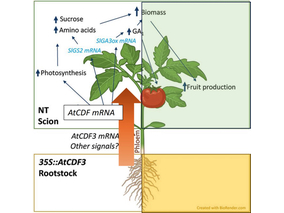
AtCDF3 gene induced greater production of sugars a...
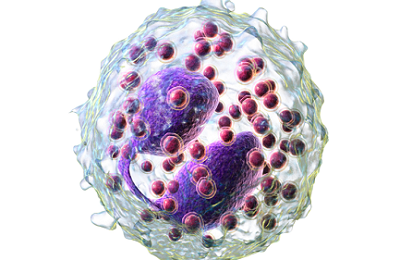
En nuestro post hablamos sobre este interesante tipo de célula del...
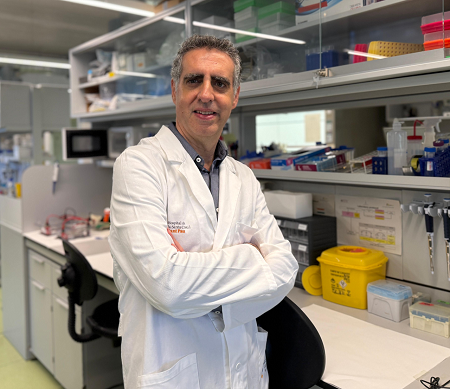
Acute myeloid leukemia (AML) does more than infiltrate the lungs: it a...