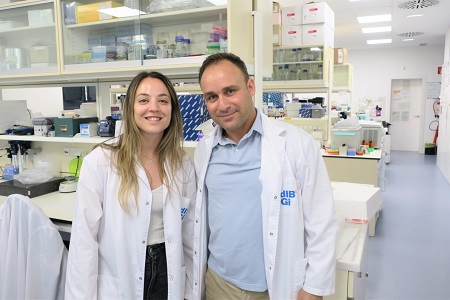
Body fat (also known as adipose tissue) is an essential endocrine organ for the body’s energy balance. When this tissue fails, the risk of developing diseases commonly associated with overweight, obesity, and aging increases. Research led by the Girona Biomedical Research Institute Dr. Josep Trueta (IDIBGI) has identified the key role of a new protein, called olfactomedin-2 (OLFM2), in body fat depots. This is the first time that the activity of this protein has been described in adipose tissue in relation to overweight and obesity.
The study results, published in Nature Communications, show that the abundance of OLFM2 in human adipose tissue is functionally linked to excess weight and the function of adipose cells, the body’s main energy stores. The research team, led by Dr. Francisco José Ortega, head of the Cellular and Translational Biology Research Group at IDIBGI, emphasizes that this new protein is not only an important regulator of adipose cells, but that its partial loss in the fat depots of people with obesity may promote inappropriate activity detrimental to health. Altogether, this favors the accumulation of fat mass and compromises the systemic metabolism of people with obesity.
As Dr. Ortega, the lead investigator of the study, explains: “The name of this protein family comes from its discovery in the olfactory epithelium of the bullfrog in the early 1990s. At first, it was thought they were exclusive to the sense of smell, but it was soon found that some variants, such as olfactomedin-2, are present in other tissues and regulate essential physiological processes. For this reason, changes in their abundance or function can promote the development of diseases ranging from cancer to glaucoma, and they are involved in growth processes as important as menarche (the onset of puberty in women). We now also know that it plays a key role in the function and development of adipose tissue.”
“In recent years, the communication between the sense of smell and energy balance has been studied with increasing interest,” adds the IDIBGI researcher. “Directly related to the body’s energy needs, molecules that transmit olfactory signals influence, beyond food intake, the way food is utilized once ingested. In addition to fat, olfactomedin-2 is expressed in the hypothalamus, where it may also influence the amount of body fat stored by acting from and on the central nervous system.”
This new IDIBGI study describes for the first time its presence and a previously unknown biological function in adipocytes, the main cells of fat depots, highlighting the relevance of this protein in the context of clinical endocrinology and systemic metabolism. “The results presented allow us to conclude that olfactomedin-2 produced by adipose tissue is functionally related to obesity and highlight the importance of this olfactomedin in maintaining healthy adipose tissue and an energetically balanced physiological state,” concludes Dr. Ortega.
The scientific article, with Dr. Aina Lluch as the first author, expands knowledge about the function of adipocytes, a paradigmatic cell in the field of endocrinology and nutrition, contributing to a better understanding of body fat function and obesity pathophysiology, and generating interesting avenues for future research. Researchers from the University of Marburg (officially Philipps-Universität Marburg) in Germany, Cardiff and Oxford Universities in the United Kingdom, and collaborators from the National Institutes of Health (NIH) in the United States participated in the study. Nationally, the study involved the Universities of Barcelona, Córdoba, and Santiago de Compostela, and the Centro de Investigación Biomédica en Red (CIBER).
Reference article: https://www.nature.com/articles/s41467-025-62430-5
Lluch A, Latorre J, Espadas I, Oliveras-Cañellas N, Moreno-Navarrete JM, Caballano-Infantes E, Sarker G, Malvido NF, Garrido-Gil P, Labandeira-García JL, Nakaya N, Mora S, Chicano E, López-Alcalá J, Malagón MM, Martín-Montalvo A, Zhang B, Zhou Y, Domingos AI, López M, Pörschke J, Gómez-Serrano M, Szymanski W, Graumann J, Tomarev SI, González-García I, Fernández-Real JM, Ortega FJ. Defective Olfactomedin-2 connects adipocyte dysfunction to obesity. Nat Commun. 2025; 16(1):7154. doi: 10.1038/s41467-025-62430-5. PMID: 40759652; PMCID: PMC12322249.

La mejor actitud que podemos adoptar es la de trat...

The research team observed changes in head circumf...

AtCDF3 gene induced greater production of sugars a...

En nuestro post hablamos sobre este interesante tipo de célula del...

Telum Therapeutics, a biotechnology company leveraging proprietary met...