An international multicenter study has analyzed the largest cohort published so far of people with NKX2-1-related disorders. The work, titled International Registry of NKX2-1-Related Disorders: Clinical, Genetic, and Imaging Perspectives, published in the scientific journal Movement Disorders, included 68 patients with genetically confirmed diagnosis and collected clinical, genetic and neuroimaging information through an international registry coordinated from SJD Barcelona Children's Hospital in Barcelona. The main finding is that early motor delay is the most frequent initial manifestation and that there are relevant associations between the type of genetic variant and the clinical evolution, especially in relation to respiratory involvement and chorea, a movement disorder characterized by involuntary, abrupt and irregular movements that can affect the face, arms or legs.
NKX2-1-related disorders
NKX2-1-related disorders are genetic diseases caused by alterations in the NKX2-1 gene. This gene is essential for the development of the brain, lungs and thyroid gland.
Traditionally they are described by the involvement of three main organs:
- Brain (movement disorder, especially chorea)
- Lungs (respiratory problems, often from birth)
- Thyroid (hypothyroidism)
However, the clinical expression is variable, which makes diagnosis and prediction of prognosis difficult.
Main results of the study
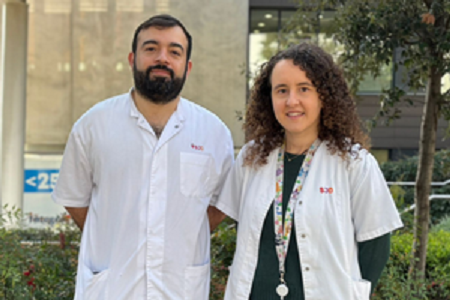
Laia Nou, MD, pediatric neurologist at SJD Barcelona Children's Hospital (HSJD) and first author of the article, and Dario Ortigoza, MD, PhD, researcher of the Epilepsy and Movement Disorders in Pediatrics research group at the Institut de Recerca Sant Joan de Déu (IRSJD), pediatric neurologist at SJD Barcelona Children's Hospital (HSJD) and author of the article, comment that this study redefines our clinical expectations in NKX2-1-related disorders. It shows that early motor delay may precede chorea and that certain genetic variants are associated with specific clinical trajectories. These findings make it possible to move towards earlier diagnosis and personalized care based on genotype.
Importance for future research
The results highlight the need to carry out long-term follow-up studies, with periodic and standardized evaluations of the neurological, respiratory and endocrine status of patients. In addition, the observed relationship between the type of genetic alteration and clinical symptoms opens new opportunities to improve care and research, such as:
In short, the study shows that early motor delay is usually the first sign of the disease, even before chorea appears. In addition, it confirms that the type of genetic alteration can help anticipate the clinical evolution. These findings facilitate earlier diagnosis and more personalized care.

La mejor actitud que podemos adoptar es la de trat...

The research team observed changes in head circumf...
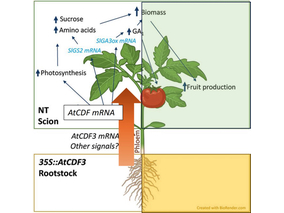
AtCDF3 gene induced greater production of sugars a...
En nuestro post hablamos sobre este interesante tipo de célula del...

Telum Therapeutics, a biotechnology company leveraging proprietary met...