A significant advance in the field of artificial intelligence (AI) could transform the way respiratory asynchronies are detected and managed in patients on mechanical ventilation. Researchers from the Parc Taulí Institute of Research and Innovation (I3PT) have recently published a study in the journal BMJ Health Care Informatics that reveals the surprising potential of large language models (LLMs), such as Chat GPT, Claude, Gemini o Deepseek, in generating code capable of classifying these complex desynchronizations complex with high precision.
Patient-ventilator asynchronies, mismatches between the patient's breathing and the machine's support, are a common problem in Intensive Care Units (ICUs). Detecting and classifying them is crucial for optimal care, but traditionally requires an exhaustive analysis of physiological signals by expert teams, a process that can take weeks.
The human ingenuity behind AI
Before this latest discovery, the I3PT team —made up of doctors and engineers— had already developed a pioneering AI algorithm capable of early detection and classification of flow asynchronies. Francesc Suñol, first author of the study, explains:
“Our algorithm learns from previous cases and recognizes patterns in breathing signals to identify mismatches and their severity.”
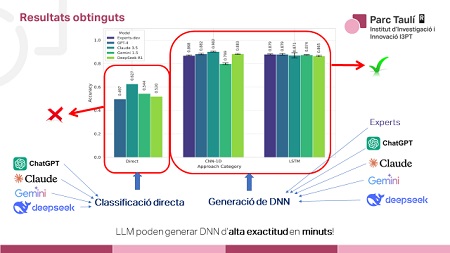
The question the researchers asked themselves was whether the new LLMs could directly recognize and classify these asynchronies without prior training. The initial answer was a clear no— these models, on their own, are not capable of performing this specific task..
The surprise: LLMs as code developers
However, the real breakthrough came when the team asked the LLMs to generate code for a neural network designed for this classification task. The results were "excellent", according to researchers. The code generated by the AI models obtained, in minutes, a performance almost identical to what the I3PT team had developed over weeks of work.
Enhancing human expertise, not replacing it
These results do not imply the replacement of human expertise, but rather enhance it. Leonardo Sarlabous, coordinator of the Signals Laboratory and last author of the study, emphasizes
"This technology does not replace human expertise, but rather complements it. The supervision of an expert professional is still required to validate the results."
Sarlabous emphasizes the broader implication of this research: “This shows that LLMs are not just chatbot tools; —they can assist in developing powerful clinical models faster, with minimal human coding.”
The study concludes that, while LLMs cannot replace specific training for asynchrony classification, they can act as “powerful assistants” to generate the necessary toolsDespite the promising efficiency and resource savings that this advance could bring to hospital settings, Sarlabous warns that “there is a long way to go before we see these tools in clinical practice; validation and ethical oversight remain essential.”
Reference article: Suñol F, de Haro C, Santos-Pulpón V, Fernández-Gonzalo S, Blanch L, López-Aguilar J, Sarlabous L. Leveraging large language models for patient-ventilator asynchrony detection. BMJ Health Care Report. 2025 Jun 27;32(1):e101426. doi: 10.1136/bmjhci-2024-101426. PMID: 40578847; PMCID: PMC12207101. https://pubmed.ncbi.nlm.nih.gov/40578847/
Image: Suñol, F (2025, June) Detection of patient-ventilator asynchronies by means of extensive language models. [Oral communication]. Sabadell

La mejor actitud que podemos adoptar es la de trat...

The research team observed changes in head circumf...

AtCDF3 gene induced greater production of sugars a...
En nuestro post hablamos sobre este interesante tipo de célula del...

Telum Therapeutics, a biotechnology company leveraging proprietary met...