The study describes how mutations in the GUK1 gene are responsible for causing this new form of Mitochondrial DNA Depletion-Deletion Syndrome (MDDS), which is different to those that had been described to date.
Glòria Garrabou leads the Hereditary metabolic diseases and muscular disorders research group, which is also part of the CIBER on Rare Diseases (CIBERER). This group has participated in a multi-centre study that has identified new mutations in the GUK1 gene causing MDDS that had not been discovered to date, with the findings published in the journal Annals of Neurology.
MDDS is a group of rare hereditary genetic diseases in which patients have molecular alterations in one or more genes that affect the quantity and quality of DNA in the mitochondria (mtDNA) of their cells. To date, mutations had been described in several genes, such as TK2, SUCLA2, SUCLG1, RRM2B, MPV17 and DGUOK, among others. Each of these alterations affects the mitochondria differently but, ultimately, they do not function properly, causing health problems for those affected. The prognosis for these patients is serious, even causing death in young children. Although there is currently no cure, there are treatments to counteract and reduce the symptoms.
What has been discovered in this study?
The article explains how four patients with symptoms of MDDS but who did not present with the known mutations of the pathology were identified. Genetic studies were carried out to identify the cause and it was seen that the GUK1 protein, which metabolises nucleotides, was not working properly. The group led by Glòria Garrabou identified the genetic variants of the GUK1 gene and also conducted the first experiments that demonstrated the pathogenic effect of the mutation at the molecular level. “It has been necessary to carry out exhaustive studies to validate the results and to be able to demonstrate that this was the cause of the disease", say the IDIBAPS researchers involved in the discovery.
Apart from discovering this mutation, they also experimentally demonstrated that the new-generation treatments for other MDDS that already exist are effective for this new syndrome, making the therapy accessible to these patients.
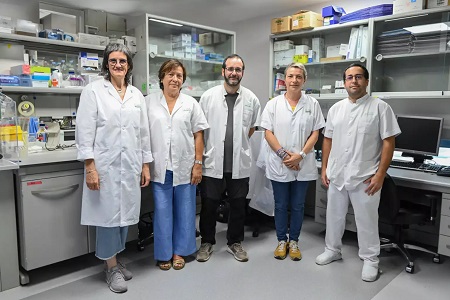
Image: From left to right: researchers Laura Gort, Antònia Ribes, Frederic Tort, Glòria Garrabou and José Milisenda.
Article reference: Hidalgo-Gutierrez, A., Shintaku, J., Ramon, J., Barriocanal-Casado, E., Pesini, A., Saneto, R.P., Garrabou, G., Milisenda, J.C., Matas-Garcia, A., Gort, L., Ugarteburu, O., Gu, Y., Koganti, L., Wang, T., Tadesse, S., Meneri, M., Sciacco, M., Wang, S., Tanji, K., Horwitz, M.S., Dorschner, M.O., Mansukhani, M., Comi, G.P., Ronchi, D., Marti, R., Ribes, A., Tort, F. and Hirano, M. (2024), Guanylate Kinase 1 Deficiency: A Novel and Potentially Treatable Mitochondrial DNA Depletion/Deletions Disease. Ann Neurol. https://doi.org/10.1002/ana.27071

La mejor actitud que podemos adoptar es la de trat...

The research team observed changes in head circumf...
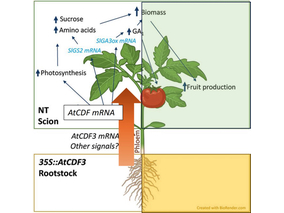
AtCDF3 gene induced greater production of sugars a...
En nuestro post hablamos sobre este interesante tipo de célula del...

Telum Therapeutics, a biotechnology company leveraging proprietary met...