The kick off signal for puberty begins in the brain. Specifically, in the hypothalamus, where specific neurons release a hormone that activates the hypophysis, at the base of the skull, which then releases other hormones to start maturation of the gonads –ovaries or testes–. This mechanism, which ultimately leads to a fertile organism, is known as the hypothalamic-pituitary-gonadal (HPG) axis.
A study by Spain’s National Cancer Research Centre (CNIO) has just discovered in animal models that two previously unsuspected elements are also involved in this hormone regulating system: microglia – defensive cells of the nervous system – and the protein RANK, which contributes to bone remodelling and is essential in the function of the mammary glands.
The article is published in the journal Science. It is led by Eva González-Suárez, head of the CNIO Transformation and Metastasis Group, who discovered in 2010 the key role played by RANK in the development of breast cancer. The first author is Alejandro Collado, a researcher from the same group and co- corresponding author.
Immune cells to modulate fertility
The hypothalamic-pituitary-gonadal axis regulates many processes related to reproduction. Its main players in the hypothalamus are the gonadotropin-releasing hormone neurons (GnRH). Gonadotropins are two pituitary hormones that control the onset of puberty, the development of the gonads, and fertility. It was previously known that GnRH neurons are modulated by other neurons, but not that immune cells could influence their functionality.
This is the newly discovered function of microglia, cells in the central nervous system that eliminate potential threats and unnecessary molecules. “Finding fertility-regulating cells that are not neurons, but rather immune cells, is important,” highlights González-Suárez.
The study shows that the way microglia regulate the function of GnRH neurons is by expressing the RANK protein.
When the CNIO group suppressed RANK expression in animal models, the reproductive function became distorted, both in males and females. In specimens born without RANK, or when it was removed in prepubescent animals, there was a reduction in sex hormones and a loss of gonad function, known as hypogonadism, and puberty was delayed in these animals. When RANK was eliminated in sexually mature specimens, they became infertile within a month.
New mutations for a human syndrome
To investigate whether RANK might play a role in human fertility, researchers genetically analysed samples from patients with congenital hypogonadotropic hypogonadism, a rare genetic syndrome associated with delayed or absent puberty and infertility. It was known that it is caused by problems in GnRH neurons or in the molecules they produce. The research identified mutations in the gene encoding the RANK protein in some patients.
“These results show that RANK could be a therapeutic target for endocrine disorders and syndromes affecting fertility, as well as a candidate gene for the molecular diagnosis of congenital hypogonadotropic hypogonadism,” according to the authors.
González-Suárez emphasises that “the role of microglia in regulating the function of ‘reproductive’ neurons is new, and this regulation associated with RANK can occur in other axes, for other functions, such as the appetite-satiety axis, the stress axis, etc.”
The importance of collaboration
The authors also want to highlight this research as an example of the importance of interdisciplinary collaboration. “My doctoral thesis started out with the question of whether the RANK protein played any role in the development of mammary tissue, in the breast itself, during puberty,” Collado explains. “When we realised that we needed to explore issues implying fertility, neurons and brain cells, we started consulting colleagues from other fields.”
Thus, the team began collaborating with Manuel Tena-Sempere, from the University of Córdoba and the Maimónides Biomedical Research Institute in Córdoba (IMIBIC), Vincent Prevot from Inserm (France’s National Institute of Health and Medical Research), Rafael Fernández Chacón from the Seville Biomedicine Institute (IBiS) (University Hospital Virgen del Rocío-CSIC-University of Sevilla), and Nelly Pitteleoud from the Centre Hospitalier Universitaire Vaudois (CHUV) in Switzerland.
“We have reached conclusions that we could not have foreseen and learned techniques and tools that we will now be able to apply to future studies,” Collado states.
Funding entities European Research Council (ERC), “la Caixa” Foundation, Community of Madrid, and Ministry of Science, Innovation and Universities through the State Research
About the National Cancer Research Centre (CNIO)
The National Cancer Research Centre (CNIO) is a public research centre under the Department of Science, Innovation and Universities. It is the largest cancer research centre in Spain and one of the most important in Europe. It includes around five hundred scientists, along with support staff, who are working to improve the prevention, diagnosis and treatment of cancer.
Reference article: Alejandro Collado-Sole, Nozha Borjini, Jing Zhai, Francisco Ruiz-Pino, Gonzalo Soria-Alcaide, Cintia Folgueira, Celia García-Vilela, Beatriz Romero-de la Rosa, Victor Lopez, Yassine Zouaghi5, An Jacob, Bella Mora-Romero, Alexandra Barranco, Guillermo Yoldi, Karine Rizzoti, Guadalupe Sabio, Gema Perez-Chacon, Patricia G. Santamaria, Jose Antonio Esteban, Nathalie Journiac, Vincent Prevot, Alberto Pascual, Rafael Fernández-Chacón, Manuel Tena-Sempere, Nelly Pitteloud and Eva Gonzalez-Suarez, Microglia Rank signaling regulates GnRH neuronal function and the hypothalamic-pituitary-gonadal axis, Science, 2026
DOI: 10.1126/science.aeb6999
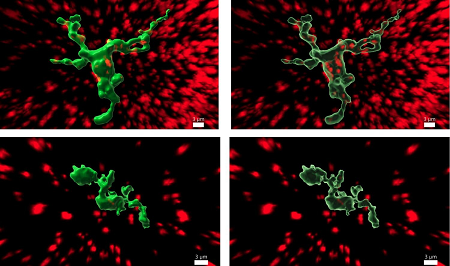
Image: Microglia cells (green) interacting with GnHR neurons (red) in mice hypothalamus from both the control group (top) and the group with supressed Rank protein (bottom). Without Rank, microglia cells are smaller and with less ramifications. Right: microglia cells from the outside. Left: inside of microglia cells. Nozha Borjini and Rafael Fernández Chacón / IBiS

La mejor actitud que podemos adoptar es la de trat...

The research team observed changes in head circumf...
AtCDF3 gene induced greater production of sugars a...
En nuestro post hablamos sobre este interesante tipo de célula del...

Telum Therapeutics, a biotechnology company leveraging proprietary met...