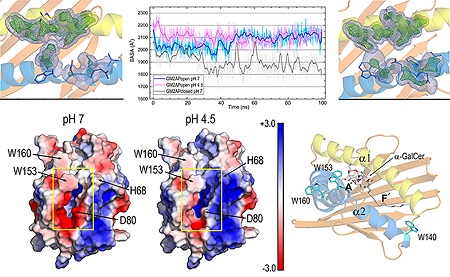
Allergy can be considered as an overreaction of the immune system to the presence of usually harmless molecules (allergens). In the case of plant allergens on which our research is focused, increasing evidence points to lipids or compounds having lipidic segments as the type of molecules that provoke many plant allergies. Proteins in charge of presenting antigens to T-cell receptors that trigger the cascade of molecular events associated to immune responses are the main players in the initial stages of the process. Among those proteins, CD1d (one of the five CD1 isotypes in humans), is responsible for presentation of lipid antigens. We report here the second part of our structural study on CD1d, of which the first part has been recently published (see CBGP News, 07 April 2020). Our computational analyses have unveiled three tryptophan residues unique to CD1d among all the CD1 proteins that could play a crucial role in trafficking and loading of lipidic molecules in different cellular compartments. Those three amino acids are completely exposed to the solvent and participate in the flexibility and the pH-dependent activity of the CD1d protein.
Original Paper:
Cuevas-Zuviría, B., Mínguez-Toral, M., Díaz-Perales, A., Garrido-Arandia, M., Pacios, L.F. 2020. Structural Dynamics of the Lipid Antigen-Binding Site of CD1d Protein. Biomolecules 10, 532. DOI: 10.3390/biom10040532

La mejor actitud que podemos adoptar es la de trat...

The research team observed changes in head circumf...

AtCDF3 gene induced greater production of sugars a...

En nuestro post hablamos sobre este interesante tipo de célula del...

Telum Therapeutics, a biotechnology company leveraging proprietary met...